#adReader-supported: we may earn a commission if you buy through our links, at no extra cost to you. It never decides a ranking. How we pick · Disclosure
Manual figures as of Sep 21, 2026. Every hole size, bag count and cure time on this page was read from the manufacturer's own install manual or installation page on that date, and each is linked. Makers revise manuals without notice: confirm on the linked page (and the paper manual in your box) before you dig, and tell us if a figure has changed.
The short version
This question gets asked in one of two forms, and they have different answers.
“Can I bolt a hoop to the concrete I already have?” For a full-size in-ground system: no, not as an approved installation. The pole is not held up by the surface it stands on, it is held up by a mass of concrete several feet underground, and a driveway slab is nowhere near that. Expansion or epoxy anchors into four inches of slab are not a substitute, and no maker whose documents this site cites publishes that method.
“Can I put a hoop up without pouring new concrete?” Yes, by not using an in-ground hoop. A portable with its base filled, or a wall-mounted system bolted into structure, both put a regulation rim over your existing driveway without a bag of mix in sight. Those are real answers, not compromises, and they are the right answer for a lot of households.
The sections below work through each route with the published figures, and then deal with the variants people ask next: asphalt, grass, and the sidewalk at the end of the drive.
Why the slab is not a footing
It is worth understanding why the mass has to be that deep, because it explains why bolting to the surface cannot substitute. A basketball pole is a tall lever. Every shot that hits the board, and every player who hangs on the rim, applies a turning force at the base. What resists it is not the strength of the bolts but the weight and depth of concrete the pole is tied into, plus the soil pressing on the sides of that column. Four inches of slab gives you neither. The anchors would be the first thing to fail, and they would take a cone of your driveway with them when they did.
What the makers actually publish
This site's rule is to quote documents rather than opinions, so here is what the relevant pages say, every one read on the date given.
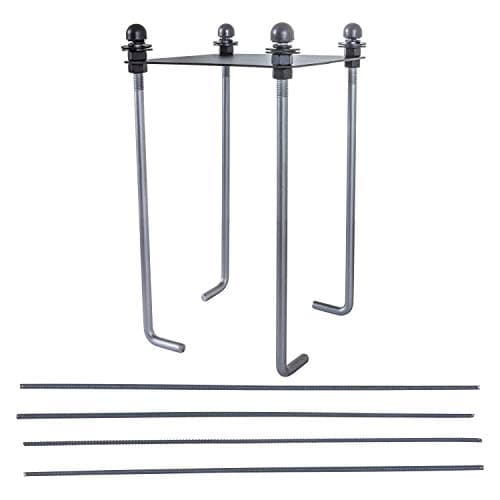
- Goalrilla's 9-inch anchor kit page states the anchor “is installed in concrete” and that the design lets you unbolt the hoop if you move house. It lists which Goalrilla systems it fits and states plainly that it is not compatible with Silverback or Goaliath goals or with 7-inch anchor bolts. It publishes no alternative method for an existing slab.
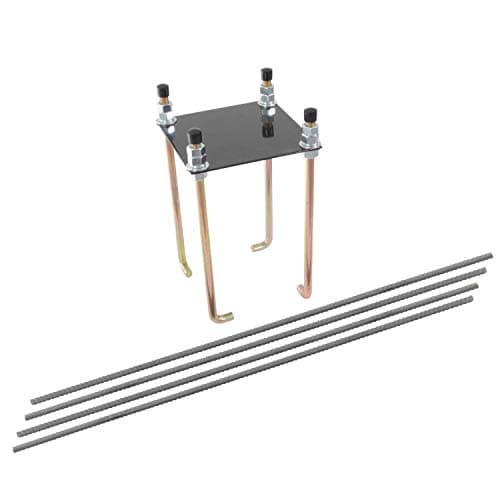
- The Silverback 7-inch anchor kit ships a plate, J-bolts, nuts, washers and rebar — rebar being the giveaway, because rebar goes into concrete you are pouring, not concrete that has already cured.
- Lifetime's installation article describes only new holes and fresh pours, for both its direct-bury and its bolt-down systems. Existing concrete, slabs and asphalt are not mentioned anywhere on it.
- The Silverback SB60 manual adds a constraint people miss even when they are digging: 18 inches of minimum clearance behind the pole. On an existing driveway that is often what decides where the hole can go, before anything structural does.
Absence of a published method is not the same as proof that nothing works — but it does mean that anchoring to an existing slab is outside every warranty on this site, and this page is not going to invent a procedure that no manufacturer stands behind. Anchor kits explained covers which plate fits which hoop, and the fact that the 7-inch and 9-inch patterns do not interchange.
Route 1: cut the slab and dig through it
This is the proper in-ground answer on an existing driveway, and it is what professional installers do. You saw-cut a square opening in the slab where the pole will stand, break out and remove that piece, dig the footing specified in your hoop's manual beneath it, set the anchor plate level, pour, cure for the published minimum, and patch around the pole afterwards.
What it costs beyond a normal install: the cutting. A concrete saw is a rental rather than a tool most households own, cutting reinforced slab is slow, and the opening has to be big enough to work the hole and to get a 20-inch top form in on an Escalade footing. Factor a half-day and a rental before the dig even starts. In-ground installation cost prices the hired version, which on an existing slab is often the sensible call.
Two details decide whether the result looks deliberate or looks like a repair. First, cut a clean square or rectangle with straight edges rather than breaking out a ragged hole — the patch line will be visible forever and a straight one reads as intentional. Second, keep the finished pour slightly proud of nothing: flush with the slab, not above it, or you have made a trip hazard in the middle of the playing surface. How to install an in-ground hoop covers the rest of the sequence, and which mix to use covers the pour itself.
Route 2: put the footing beside the slab, not through it
This is the route nobody suggests and it is frequently the best one. The pole does not have to stand on the driveway. It has to stand close enough that the board overhangs the playing area — and every in-ground system on this site publishes an overhang figure precisely because the board sits out in front of the pole.
The Silverback SB60 publishes 2.5 feet of overhang (its manual says 27 inches at a 10-foot rim). Goalrilla's FT60 publishes 3.5 feet, and the 72-inch systems from Goalrilla, Mega Slam, Pro Dunk and Goalsetter all publish four. That means a pole set in soil or a border two to three feet off the edge of the driveway can put the backboard over the concrete anyway, with no cutting, no patching and a much easier dig.
The trade-offs are honest ones. You need soil, not another slab, in that strip. The further back the pole, the more of the board's overhang is spent getting back to the playing surface rather than giving you clear space to drive into. And the footing is still the full depth the manual specifies — this route saves you the saw, not the hole. Overhang explained collects every published figure on the site so you can work out how far back your particular hoop can afford to sit, and where to put a hoop in your driveway works through the geometry including the rear clearance the manuals require.
Route 3: a portable, with the base actually filled
The honest answer for most households asking this question. A portable needs no footing at all: it stands on the concrete you already have, it comes with you if you move, and it leaves nothing behind.
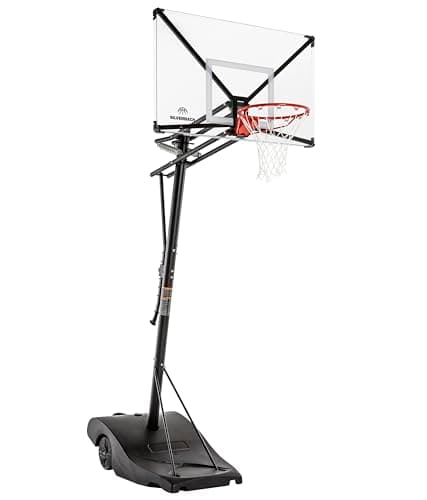
Two things make the difference between a portable that feels solid on a driveway and one that does not. What the pole bolts to is the first — a system where the pole connects to a steel chassis beneath the base behaves very differently from one where it bolts into the plastic, which is the part that cracks. How the base is filled is the second, and it is the step people shortcut. Water is easier; sand is roughly 30 to 40 percent denser and does not freeze. How to fill a portable base has the worked weights for every published base capacity on this site, and wind and tipping covers what a half-filled base does on an exposed slab.
Add ballast on top if the hoop lives somewhere windy or gets played on hard. A purpose-made weight bag holding up to 100 lb of sand sits on the base and looks like part of the hoop; a pair of cinder blocks does the same job and looks like a building site. Either is better than a hoop that walks backwards every time somebody shoots. Best portable hoops ranks the field, and in-ground vs portable is the honest version of the trade.
Route 4: the wall instead of the ground
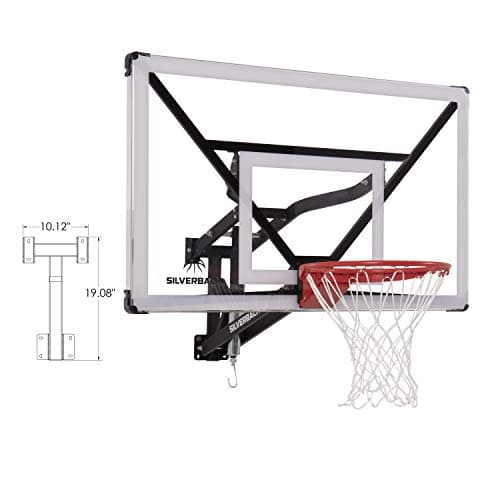
If the slab runs up to a garage, the structure beside it may be a better foundation than anything under it. A wall-mounted system bolts to the building, uses no driveway space at all, and on the better units adjusts through the same 7.5-to-10-foot range as a pole hoop with 2.5 feet of overhang so the shooter still stands out on the concrete.
The constraints are specific and worth reading before you commit, because drilling into a building has no undo. Escalade's own page for the NXT 54 Wall Mount states that mounting hardware is not included and says to avoid attaching to any brick surface or facade — brick veneer is a cladding, not structure. You are fixing into framing or masonry that can carry the load, and if you cannot identify what is behind the surface, this is the route to skip. Best wall-mounted hoops ranks the category and best hoops for a garage covers the garage-door header, track clearance and panel-protection problems specifically.
What about asphalt?
Everything above applies, with one thing worse and one thing easier.
Worse: asphalt is a flexible pavement. Concrete is rigid and spreads load; asphalt deforms, especially when it is warm. It is an even poorer candidate for surface anchors than a concrete slab, and it moves seasonally around anything rigid set through it. Not one maker cited on this site publishes an asphalt-specific installation procedure — the manuals specify concrete footings and nothing else — so there is no approved method to quote you, and this page will not make one up.
Easier: cutting it. Asphalt cuts and breaks out far more readily than reinforced concrete, so route 1 is a genuinely smaller job on an asphalt drive than on a concrete one. You still dig the full footing beneath it and you still pour concrete into that hole — the footing is concrete regardless of what the surface is made of.
The patch is the part to think about in advance. A cold-patch repair around a pole never matches the surrounding surface and it is usually the visible scar of the whole project. If appearance matters, route 2 — the footing in soil beside the asphalt, with the board overhanging it — is worth serious consideration, as is a portable.
One thing a slab you cannot anchor to does take happily is a surface. Modular court tile lays on top of concrete or asphalt with nothing glued or drilled, which is the one upgrade an existing slab accepts without argument: best basketball court tiles ranks the live systems on thickness, published load rating and drainage, and is clear that a floating tile deck is not a footing.
What about grass?
Grass is fine for an in-ground hoop and bad for a portable, which is the reverse of what people expect.
In-ground on grass works well, and it is the easiest version of the install: no cutting, soft digging, and the spoil from the hole has somewhere to go. It is route 2 by another name. What you lose is the playing surface — the hoop is only useful if the board overhangs something hard, so check the overhang figure against the distance from the lawn edge to where you want to shoot from.
Portables on grass are a problem. A filled base is several hundred pounds concentrated on a small footprint. On turf it sinks, it goes out of level, it kills the grass beneath it, and an out-of-level base makes a tall hoop much easier to tip. If a portable has to live on grass, set it on paving slabs or a prepared pad so the load spreads and the base stays level.
The sidewalk, the curb and the street
Asked often enough to answer directly: the sidewalk and the strip between it and the road are usually public right-of-way rather than your property, even where you are the one who has to mow and shovel them. Installing anything permanent there is a question for your municipality, not for a hoop manufacturer, and rules vary enough between jurisdictions that no honest national answer exists. Call the local authority before buying anything.
A portable hoop rolled onto the street is a different and more common issue, and the practical objection is the same everywhere: a hoop in the roadway puts children in the roadway. If the reason the hoop wants to be out there is that the driveway is short, the better fixes are a hoop with more overhang so less of the slab is wasted behind the pole, and a net to stop balls reaching the road. Yard guards and driveway nets covers the second, and best hoops for a small driveway covers the first.
What each route needs
Our picks for this
The hardware behind each of the four routes
Routes 1 and 2 both end in a poured footing, so they need the anchor plate that matches your hoop's bolt pattern - and the two patterns on this site do not interchange. Routes 3 and 4 need no concrete at all.
Best anchor kit for Silverback / Goaliath
Silverback 7" Basketball Hoop Anchor Kit (B1030)
Warranty: not published8.2/10Route 1 or 2, Escalade hoops: the 7-inch pattern for Silverback SB and SBX, Goaliath Ignite and Prodigy. Plate, J-bolts and rebar, cast into the fresh pour.
$109.95Amazon#ad · Price as of November 3, 2026 · Disclosure for the link to Silverback 7" Basketball Hoop Anchor Kit (B1030)
Best anchor kit for Goalrilla
Goalrilla 9" Basketball Hoop Anchor Kit (B1002)
90-day warranty8.2/10Route 1 or 2, Goalrilla hoops: the 9-inch pattern. Its own page states it is not compatible with Silverback or Goaliath, so the plate has to be bought before the concrete goes in.
$149.95Amazon#ad · Price as of November 3, 2026 · Disclosure for the link to Goalrilla 9" Basketball Hoop Anchor Kit (B1002)
Best portable overall
Silverback NXT 54 Portable
Warranty: not published7.9/10Route 3: the pole bolts to a steel chassis beneath the base rather than to the plastic, with 26 inches of clear space under the goal. No footing, no cutting, no patch.
$549.95Amazon#ad · Price as of November 3, 2026 · Disclosure for the link to Silverback NXT 54 Portable
Best wall-mounted hoop overall
Silverback NXT 54 Wall Mount
5-yr warranty7.6/10Route 4: a 7.5-to-10-foot crank adjustment and 2.5 feet of overhang off the building. Mounting hardware is not included and Escalade rules out brick facades.
$439.95Amazon#ad · Price as of November 3, 2026 · Disclosure for the link to Silverback NXT 54 Wall Mount
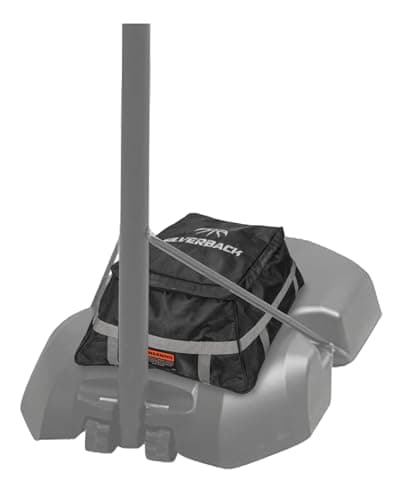
Best portable hoop ballast
Silverback Portable Basketball Hoop Weight Bag
Warranty: not published8.3/10Route 3, after the base is full: up to 100 lb of sand sitting on top of the base, for a windy slab or hard play.
$49.95Amazon#ad · Price as of November 3, 2026 · Disclosure for the link to Silverback Portable Basketball Hoop Weight Bag
How we picked
What earns a pick on this page
Every pick here is built from figures you can check for yourself: the maker's published backboard, pole, overhang and adjustment specs; the hole size, bag count and cure time printed in its install manual; the warranty term in the maker's own wording, exclusions included, with the date we read it; and the failure patterns owners report (base cracking, backboard fogging, two-piece pole lean), which shape the “skip this if” line. Every figure links to where it came from.
Those figures go through one fixed rubric, so an 8.1 here means the same thing as an 8.1 anywhere else on the site and the top pick is the one that earns it for the driveway it is named for. Commissions never set a score or decide a pick. The rubrics and their weights are published.
Questions
Frequently asked
Can you install a basketball hoop on existing concrete?
Not by bolting a full-size in-ground pole to it. A residential driveway slab is typically 4 inches thick, while the footings specified in the manuals on this site are 30 to 48 inches deep and hold 700 to 1,700 lb of concrete — so the slab is a surface, not a foundation, and no maker cited here publishes a method for anchoring to one. The workable routes are to saw-cut the slab and dig a proper footing through it, to pour the footing in soil beside the slab and let the board overhang, or to use a portable or wall-mounted system that needs no footing at all.
How do you install a basketball hoop without concrete?
Use a hoop that does not need a footing. A portable stands on the driveway with its base filled with water or sand, and a wall-mounted system bolts to the building. Both put a regulation rim over your existing surface with no mix involved. What you cannot do is put an in-ground pole up without concrete: every in-ground manual on this site specifies a poured footing, and the pole is held up by that mass rather than by the surface it passes through.
Can you put a basketball hoop on an asphalt driveway?
Yes, but not by anchoring to the asphalt. Asphalt is a flexible pavement that deforms under load and moves seasonally, and no maker cited on this site publishes an asphalt-specific procedure. The in-ground route is the same as on concrete: cut the surface, dig the footing specified in your hoop's manual, and pour concrete into it. Asphalt is considerably easier to cut than reinforced concrete, but the patch around the pole is harder to make look right — which is why a footing in soil beside the drive, or a portable, is often the better answer on an asphalt driveway.
Can you bolt a basketball hoop to a 4-inch slab with concrete anchors?
It is outside every manufacturer specification on this site and outside the warranty. The force at the base of a basketball pole is a turning force applied through a tall lever by shots on the board and anyone hanging on the rim, and what resists it is the depth and mass of the footing plus the soil pressing on its sides. Four inches of slab provides neither, and a failure takes a cone of the driveway with it rather than just shearing a bolt.
How far from the driveway can the pole be?
As far as the hoop's published overhang allows, minus the clear space you want to play in. The Silverback SB60 publishes 2.5 feet of overhang (27 inches at a 10-foot rim in its manual), Goalrilla's FT60 publishes 3.5 feet, and the 72-inch systems from Goalrilla, Mega Slam, Pro Dunk and Goalsetter publish four. Remember the manuals also ask for clearance behind the pole — the SB60's calls for 18 inches — so a fence or wall right behind the chosen spot can rule it out.
Can a portable basketball hoop sit on grass?
It can, but it should not sit directly on turf. A filled base is several hundred pounds on a small footprint: it sinks, it goes out of level, it kills the grass under it, and an out-of-level base makes a tall hoop much easier to tip. Set it on paving slabs or a prepared pad so the load spreads and the base stays level. Grass is a good surface for an in-ground hoop, where the dig is easier than through a slab.
Do I need to call before digging through my driveway?
Yes. Gas, water, electric service and irrigation lines commonly run within a few feet of a house, and a 36- to 48-inch footing is deep enough to reach them. In the United States, 811 is the free national call-before-you-dig number and utilities mark their lines at no charge. Do it before the saw comes out, because the marks may also change where the hole can go.
Keep reading
Related on Rim & Rebound
- Best court tilesWhat you can add on top of a slab, since you cannot anchor to it.
- How to install an in-ground hoopThe full sequence once the hole is open.
- How deep to digEvery published footing depth on the site.
- Anchor kits explainedWhich plate fits which hoop, and why they do not interchange.
- Where to put the hoopSiting it, including the clearance behind the pole.
- In-ground vs portableThe decision this question usually turns into.
Receipts
Sources
- Concrete Network — "How Thick Should a Concrete Driveway Be?": a minimum thickness of 4 inches is sufficient for a residential driveway carrying a passenger vehicle or SUV, 5 to 6 inches for heavier vehicles, over a well-graded compacted gravel subbase (read 2026-10-26)
- Silverback SB60 (B5402W) owner's manual — anchor installation, assembly and Limited 7 Year Warranty (PDF hosted by Lowe's; read 2026-09-21)
- Silverback — SB60 product page (read 2026-09-21)
- Silverback — 7" Basketball Hoop Anchor Kit (B1030) product page (read 2026-09-21)
- Goalrilla — 9" Basketball Hoop Anchor Kit (B1002) product page (read 2026-09-21)
- Goalrilla Anchor Kit B1002 — Anchor System Installation Instructions (PDF hosted by BasketballGoalStore; read 2026-09-21)
- Goalrilla — Basketball Hoop Installation guide (read 2026-09-21)
- Goalrilla — FT60 product page (read 2026-09-21)
- Lifetime — "Basketball Hoop Assembly: In-Ground and Bolt-Down" (read 2026-09-21)
- Silverback — NXT 54 Portable product page (read 2026-09-21)
- Silverback — NXT 54 Wall Mount (adjustable, B8403W) product page (read 2026-09-26)
- Silverback — Portable Basketball Hoop Weight Bag (B8477W) product page (read 2026-09-21)
- QUIKRETE — Concrete Mix No. 1101 data sheet (yields per bag, water, strength; read 2026-09-21)
Every figure above is a published one you can click and check. Specs come from the maker's own product pages (linked on every product), install figures from the maker's manual or installation page with the date we read it, and warranty terms from the maker's warranty page or manual. Buy buttons go straight to the current Amazon listing, so the price you see is today's. Where a maker leaves a figure off the page, the card says “not published” rather than guessing. Read how we pick.