#adReader-supported: we may earn a commission if you buy through our links, at no extra cost to you. It never decides a ranking. How we pick · Disclosure
Manual figures as of Sep 29, 2026. Every hole size, bag count and cure time on this page was read from the manufacturer's own install manual or installation page on that date, and each is linked. Makers revise manuals without notice: confirm on the linked page (and the paper manual in your box) before you dig, and tell us if a figure has changed.
Quick picks
The rankings at a glance
| # | Product | Best for | Score | Price |
|---|---|---|---|---|
| 1 |  QUIKRETE Fast-Setting Concrete Mix (No. 1004), 50 lb Lists "Basketball posts" as a use, sets in 20 to 40 minutes, and publishes the two-bags-per-post figure. Pour dry, soak with water. | Best for a direct-bury poleWarranty: not published | 9.0 /10 | Check price · Amazon |
| 2 | QUIKRETE Concrete Mix (No. 1101), 80 lb The 4,000 psi mix the hoop manuals assume: 0.60 cu ft per 80-lb bag, meets ASTM C387, and it stays workable while you set the plate. | Best for an anchor-plate footingWarranty: not published | 8.9 /10 | Check price · Amazon |
| 3 | QUIKRETE 5000 High Early Strength Concrete Mix (No. 1007), 80 lb 1,500 psi at one day and 5,000 at 28, with a 10-to-12-hour walk-on time. | Best for cold weatherWarranty: not published | 8.6 /10 | Check price · Amazon |
| 4 | Sakrete High-Strength Concrete Mix (4,000 PSI), 80 lb Same 4,000 psi and the same 0.6 cu ft per 80-lb bag, with post setting in Sakrete's own use list. | Best alternative brandWarranty: not published | 8.6 /10 | Check price · Amazon |
| 5 | Sakrete Fast-Setting Concrete Mix, 50 lb Sets in 30 minutes, no mixing for posts, and the shortest published traffic times here. | Best fast-setting alternativeWarranty: not published | 8.5 /10 | Check price · Amazon |
#ad · Prices are set by Amazon and change often, so we don't print them. Scores are ours, built from published specs, the install manuals and quoted warranty terms, not our own measurements. Photos are illustrative stock. Tap a row for the full write-up.
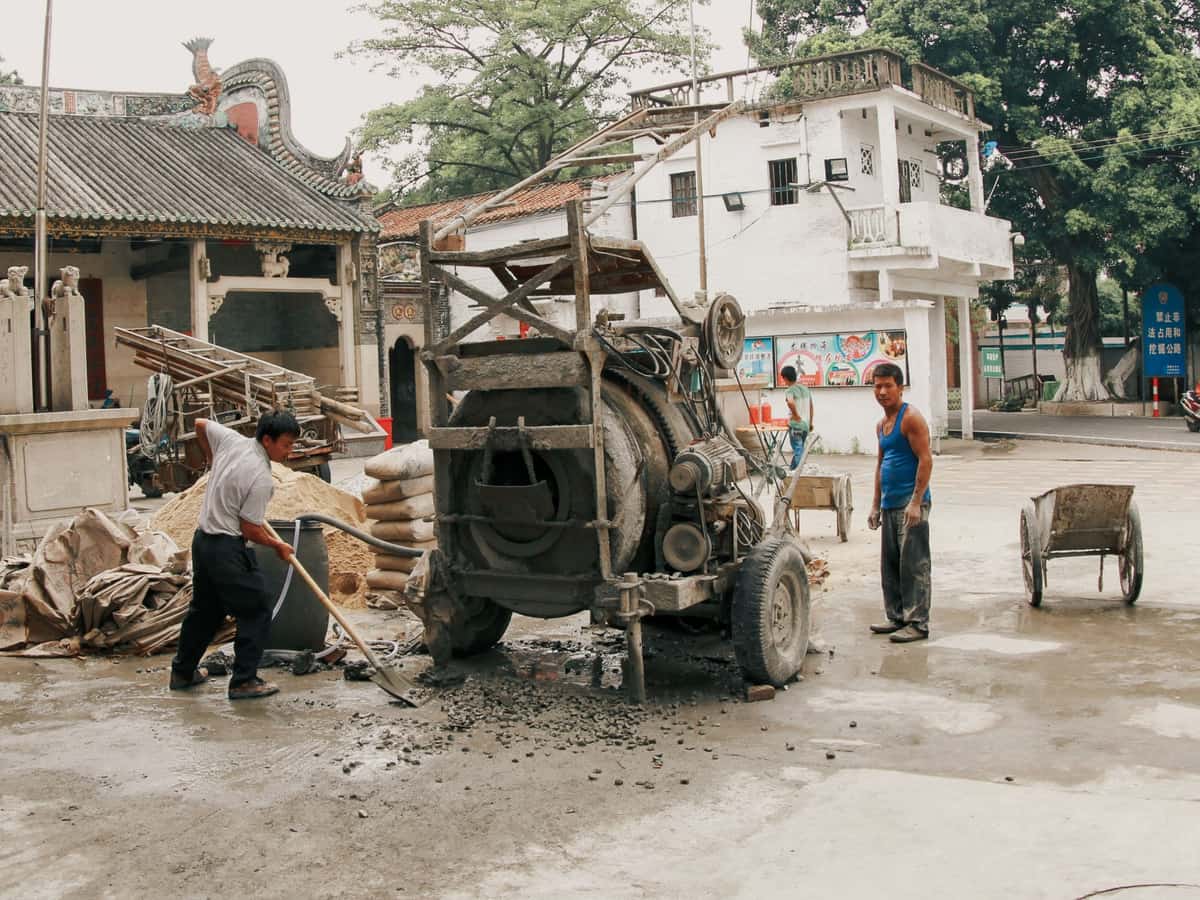
The install decides the mix, not the hoop
There are two in-ground installs, and they want opposite things from a bag of concrete.
Direct-bury. The pole itself goes into the hole and the concrete is poured around it: this is how Lifetime's in-ground systems, the Goaliath GoTek and the Silverback NXT in-ground are installed. The hole is small, the pole is braced plumb while the concrete goes off, and nobody has to finish a surface. That is exactly the job fast-setting concrete is sold for — QUIKRETE's own page lists “Basketball posts” among its uses and tells you to pour the dry mix into the hole and soak it with water.
Anchor plate. A steel plate with four J-bolts sits in a much larger footing, the top is screeded flat and level, and three days later the pole bolts down onto it. This is how Goalrilla, Goalsetter, Pro Dunk and the bolt-down Silverbacks install. Here a 20-minute set is a liability: you need time to place the plate, check it with a level in two directions, tap the rebar in and strike off the top. Use a standard 4,000 psi mix, or QUIKRETE 5000 if it is cold.
Which install you have is written on your hoop's page and in its manual. Anchor kits explained covers the difference in detail, and how to install walks the whole job.
The numbers
Bags, by hoop brand
The manuals disagree with each other because the installs differ, so use your own manual's figure. These are the published ones:
| Hoop / install | Hole (published) | Concrete (published) | Mix to buy |
|---|---|---|---|
| Goalrilla anchor kit (B1002) | 16 in diameter x 48 in deep | Eleven 80-lb bags (current guide); nine in the older kit manual | Standard 4,000 psi, or 5000 in the cold |
| Silverback 7 in anchor (SB60 manual) | 16 in diameter x 36 in deep, 20 in at the top form | Nine 80-lb bags plus four #3 x 30 in rebar | Standard 4,000 psi |
| Lifetime in-ground (assembly guide) | 21-24 in deep, 18-24 in diameter | 420-640 lb, so six to eight 80-lb bags | Fast-setting, or standard |
| Direct-bury pole, generic | Per manual; typically 9-16 in diameter | QUIKRETE: two 50-lb bags per 3 in post in a 9 in x 30 in hole | Fast-setting |
When fast-setting is right, and when it is not
Right: a direct-bury pole, a small hole, one person working alone, or a forecast that gives you an hour. QUIKRETE Fast-Setting reaches final set in 20 to 40 minutes, 1,000 psi at 24 hours and 4,000 psi at 28 days, and meets ASTM C387. Sakrete's equivalent sets in 30 minutes and publishes foot traffic at six hours.
Not right: any footing with an anchor plate to level, any pour big enough that the first bags stiffen before the last ones go in, or a footing you want to finish flush with a slab. The set time is the working time; you do not get to change your mind.
And in both cases, the cure time in the hoop manual still governs. Goalrilla and Silverback both ask for a minimum of 72 hours before the pole and board go on; Lifetime asks for three days. Fast-setting concrete lets you stop bracing the pole sooner — it does not let you hang a 60-inch glass backboard the same afternoon.
Cold weather
Two published details matter. Standard QUIKRETE Concrete Mix must be protected from freezing for the first 48 hours and kept moist while curing. QUIKRETE 5000 is sold specifically for high early strength and colder weather, reaching 1,500 psi at one day against a 10-to-12-hour walk-on time. If the hoop is going in during late autumn, the extra couple of dollars a bag for 5000 is the cheapest insurance in the project.
Call 811 before you dig, whatever mix you buy. It is free, it is the national call-before-you-dig service, and a struck line costs more than the hoop.
In detail
The picks, in full
Rank 1
Stock photoBest for a direct-bury pole
QUIKRETE Fast-Setting Concrete Mix (No. 1004), 50 lb
Lists "Basketball posts" as a use, sets in 20 to 40 minutes, and publishes the two-bags-per-post figure. Pour dry, soak with water.
Spec sheetSourced · not tested by us
How the 9.0 score breaks down
- Fit / compatibility (30%)
- 9
- Quality & durability (25%)
- 8
- Ease of use (20%)
- 10
- Value at list price (25%)
- 9
What the spec sheet supports
- The maker lists basketball posts by name and publishes the bags-per-post figure, so you can check the hole math instead of guessing
- No mixing for a post set: dry into the hole, then water, which is the difference between a one-person job and a three-person one
- Twenty to forty minutes to set means the pole is braced and plumb for half an hour, not overnight
Where it falls short
- Twenty to forty minutes is also the working time, so a big anchor-plate footing is the wrong job for it
- Fifty and 60 lb bags only, so a 16 x 48-inch anchor footing turns into a lot of bags
- Reaches 4,000 psi at 28 days, not the 5,000 of a high-early-strength mix
Skip this if…
…your hoop uses a bolt-down anchor plate in a 16-inch by 48-inch footing; that pour wants workable time and a screeded top, which a 20-minute set will not give you.
#ad · Price set by Amazon · Disclosure for the link to QUIKRETE Fast-Setting Concrete Mix (No. 1004), 50 lb
Rank 2
Stock photoBest for an anchor-plate footing
QUIKRETE Concrete Mix (No. 1101), 80 lb
The 4,000 psi mix the hoop manuals assume: 0.60 cu ft per 80-lb bag, meets ASTM C387, and it stays workable while you set the plate.
Spec sheetSourced · not tested by us
| Category | Install hardware |
|---|---|
| Warranty (quoted) | Not applicable (building material) |
| Replacement parts | None. |
| Cure time (manual) | Protect from freezing during the first 48 hours; keep moist while curing |
| Coverage | 80 lb bag yields approximately 0.60 cu ft (17 L); 60 lb: 0.45 cu ft; 50 lb: 0.375 cu ft; 40 lb: 0.30 cu ft |
| Sizes | 40, 50, 60, 80 and 90 lb bags |
| Material | Blend of portland cement, sand and gravel or stone; 4000 psi average compressive strength at 28 days, 2500 psi at 7 days |
| Includes | Water: approximately 6 pt to 9 pt (2.8-4.3 L) per 80 lb bag |
How the 8.9 score breaks down
- Fit / compatibility (30%)
- 10
- Quality & durability (25%)
- 9
- Ease of use (20%)
- 7
- Value at list price (25%)
- 9
What the spec sheet supports
- Published yield per bag, so the hole math is checkable
- Meets ASTM C387, which Goalrilla's guide calls for
- Sold at every big-box store
Where it falls short
- Eleven 80-lb bags is 880 lb to move from the curb to the hole
- Ordering bagged concrete online rarely beats a local pallet
- Not a fast-setting mix; the 72-hour cure still applies
Skip this if…
…your manual calls for fast-setting mix or you are pouring in cold weather; read the bag and the manual first.
#ad · Price set by Amazon · Disclosure for the link to QUIKRETE Concrete Mix (No. 1101), 80 lb
Rank 3
Stock photoBest for cold weather
QUIKRETE 5000 High Early Strength Concrete Mix (No. 1007), 80 lb
1,500 psi at one day and 5,000 at 28, with a 10-to-12-hour walk-on time.
Spec sheetSourced · not tested by us
How the 8.6 score breaks down
- Fit / compatibility (30%)
- 9
- Quality & durability (25%)
- 10
- Ease of use (20%)
- 7
- Value at list price (25%)
- 8
What the spec sheet supports
- Fifteen hundred psi at one day: the strongest early number of any bagged mix here, which matters when a hoop goes up in October
- Same 0.60 cu ft per 80 lb bag as the standard mix, so the bag count from your manual does not change
- Published strength at four ages, tested to named ASTM methods
Where it falls short
- Has to be mixed; there is no dry-pour post method for it
- Costs more per bag than standard concrete mix for strength a driveway hoop rarely needs
- The 72-hour cure in your hoop manual still applies, whatever the walk-on time says
Skip this if…
…you are pouring in mild weather and following the manual's 72-hour cure anyway; standard QUIKRETE Concrete Mix reaches 4,000 psi and costs less.
#ad · Price set by Amazon · Disclosure for the link to QUIKRETE 5000 High Early Strength Concrete Mix (No. 1007), 80 lb
Rank 4
Stock photoBest alternative brand
Sakrete High-Strength Concrete Mix (4,000 PSI), 80 lb
Same 4,000 psi and the same 0.6 cu ft per 80-lb bag, with post setting in Sakrete's own use list.
Spec sheetSourced · not tested by us
How the 8.6 score breaks down
- Fit / compatibility (30%)
- 9
- Quality & durability (25%)
- 9
- Ease of use (20%)
- 7
- Value at list price (25%)
- 9
What the spec sheet supports
- Post setting is named in the maker's own use list
- Identical 0.6 cu ft yield per 80 lb bag, so a bag count worked out for QUIKRETE carries straight over
- Sold in 40, 60, 80 and 90 lb bags, which helps if you are carrying them down a side path alone
Where it falls short
- The product page names no ASTM standard, where QUIKRETE's data sheet names three
- No published water quantity per bag on the product page
- Vehicle traffic at 72 hours, the same wait as everything else here
Skip this if…
…your hoop manual specifically calls for a mix meeting ASTM C387 and you want that printed on the sheet; QUIKRETE publishes it.
#ad · Price set by Amazon · Disclosure for the link to Sakrete High-Strength Concrete Mix (4,000 PSI), 80 lb
Rank 5
Stock photoBest fast-setting alternative
Sakrete Fast-Setting Concrete Mix, 50 lb
Sets in 30 minutes, no mixing for posts, and the shortest published traffic times here.
Spec sheetSourced · not tested by us
How the 8.5 score breaks down
- Fit / compatibility (30%)
- 9
- Quality & durability (25%)
- 8
- Ease of use (20%)
- 10
- Value at list price (25%)
- 7
What the spec sheet supports
- Dry-pour for posts, same as the QUIKRETE fast mix
- Foot traffic in six hours and vehicle traffic in 48, the shortest published waits of any mix here
- Thirty-minute set is a little more working time than QUIKRETE's 20-to-40-minute window at its fast end
Where it falls short
- Fifty pound bags only
- Basketball posts are not called out by name; fence posts are the example given
- The page publishes no strength-by-age table, only the 4,000 psi final figure
Skip this if…
…you want the published two-bags-per-post figure to check your hole against; QUIKRETE's data sheet prints one and this page does not.
#ad · Price set by Amazon · Disclosure for the link to Sakrete Fast-Setting Concrete Mix, 50 lb
Buyer's guide: buying concrete for a hoop
Buy it locally, by the pallet if you can
Bagged concrete is heavy and cheap, which is the worst possible combination for shipping. Ordering nine 80-lb bags online rarely beats the price at a big-box store, and most will load the pallet for you. Use the links here to check current prices and specifications, then buy whichever brand is stacked by the door.
Buy two more bags than the manual says
Goalrilla's own guide recommends 12 to 13 bags against an 11-bag footing as a buffer. Running out halfway through a pour is the one mistake you cannot fix later.
Match the strength to the manual, not to the internet
Every mix here reaches at least 4,000 psi at 28 days, which is above what any residential hoop footing needs. Goalrilla's guide asks for concrete meeting ASTM C387; QUIKRETE prints that standard on its data sheets.
Get the rebar if your manual lists it
The Silverback SB60 manual specifies four #3 x 30-inch bars, and both Escalade anchor kits include rebar in the box. Rebar is not optional when the manual names it.
Own a post level before you mix anything
A three-vial post level straps to the pole and reads plumb on two faces at once, hands free, for about $10. It is the difference between a backboard square to the court and one that is permanently off.
How we scored this
Units we claim to have tested: 0
Everyone in this category says they tested twenty hoops. We haven't stood up any of them, and we say so on every page. What we do instead: read the maker's published backboard, pole, overhang and adjustment specs; open the install manual and quote the hole size, bag count and cure time; quote the warranty term from the maker's own page or manual with the date we read it; and note the failure patterns owners report (base cracking, backboard fogging, two-piece pole lean) as reported, never as confirmed. Every figure links to where it came from.
Scores are editorial judgments from that documented research, not lab results. Commissions never set a score or decide a pick. The rubrics and their weights are published.
Questions
Frequently asked
What kind of concrete should I use for an in-ground basketball hoop?
For a direct-bury pole, a fast-setting mix: QUIKRETE Fast-Setting Concrete Mix lists basketball posts as a use, sets in 20 to 40 minutes and can be poured dry into the hole and soaked with water. For a bolt-down anchor-plate footing, use a standard 4,000 psi mix such as QUIKRETE Concrete Mix or Sakrete High-Strength, which stays workable long enough to level the plate.
How many bags of concrete do I need for a basketball hoop?
Follow your manual. Goalrilla's current install guide asks for eleven 80-lb bags in a 16 x 48-inch hole; the Silverback SB60 manual asks for nine plus four pieces of rebar in a 16 x 36-inch hole; Lifetime's in-ground guidance is 420 to 640 lb, which is six to eight 80-lb bags. Each 80-lb bag yields about 0.60 cu ft.
Can you use fast-setting concrete for a basketball hoop?
Yes for a direct-bury pole — QUIKRETE publishes that two 50-lb bags set a 3-inch post in a 9-inch hole 30 inches deep. No for a large anchor-plate footing: a 20-to-40-minute set does not leave time to place and level a plate, and an eleven-bag footing would take 17 or 18 of the 50-lb bags.
What psi concrete is needed for a basketball hoop?
Four thousand psi at 28 days is the standard and is more than a residential hoop footing needs. Goalrilla's guide calls for concrete meeting ASTM C387, which QUIKRETE Concrete Mix and Fast-Setting Concrete Mix both state they meet. QUIKRETE 5000 reaches 5,000 psi and is worth it mainly for cold-weather pours.
Can you pour concrete dry into the hole for a hoop pole?
Only with a mix sold for it. QUIKRETE Fast-Setting says to pour the dry mix into the hole and soak it with water when setting posts, and Sakrete's Fast-Setting says no mixing is required for posts. Standard concrete mix and QUIKRETE 5000 must be mixed to a 2-to-3-inch slump.
How long does the concrete need to cure before using the hoop?
Goalrilla's anchor manual and Escalade's Silverback manual both specify a minimum of 72 hours before the install continues, and Lifetime asks for three days. Fast-setting mix shortens the time you spend bracing the pole, not the cure.
Keep reading
Related on Rim & Rebound
Receipts
Sources
- QUIKRETE — Fast-Setting Concrete Mix product page (sets in 20-40 minutes; uses include "Basketball posts"; read 2026-09-29)
- QUIKRETE — Fast-Setting Concrete Mix (No. 1004) data sheet: yields, water, ASTM C387 and the two-bag post calculation (read 2026-09-29)
- QUIKRETE — Concrete Mix (No. 1101) product page (read 2026-09-21)
- QUIKRETE — Concrete Mix No. 1101 data sheet (yields per bag, water, strength; read 2026-09-21)
- QUIKRETE — QUIKRETE 5000 Concrete Mix (No. 1007) product page (read 2026-09-29)
- QUIKRETE — 5000 High Early Strength Concrete Mix (No. 1007) data sheet: strength by age, yields and water (read 2026-09-29)
- Sakrete — High-Strength Concrete Mix (4,000 PSI) product page (read 2026-09-29)
- Sakrete — Fast-Setting Concrete Mix product page (read 2026-09-29)
- Goalrilla Anchor Kit B1002 — Anchor System Installation Instructions (PDF hosted by BasketballGoalStore; read 2026-09-21)
- Goalrilla — Basketball Hoop Installation guide (read 2026-09-21)
- Silverback SB60 (B5402W) owner's manual — anchor installation, assembly and Limited 7 Year Warranty (PDF hosted by Lowe's; read 2026-09-21)
- Lifetime — "Basketball Hoop Assembly: In-Ground and Bolt-Down" (read 2026-09-21)
- Johnson Level & Tool — 175-O Post & Pipe Level product page (read 2026-09-21)
- 811 Before You Dig — the free national call-before-you-dig service (read 2026-09-21)
We haven't stood one of these up ourselves and we don't pretend to. Units we claim to have tested: 0. Specs come from the maker's own product pages (linked on every product), install figures from the maker's manual or installation page with the date we read it, and warranty terms from the maker's warranty page or manual. Amazon prices change often, so we don't print them. Where a figure isn't published, we say so. Read how we pick.