#adReader-supported: we may earn a commission if you buy through our links, at no extra cost to you. It never decides a ranking. How we pick · Disclosure
Manual figures as of Sep 21, 2026. Every hole size, bag count and cure time on this page was read from the manufacturer's own install manual or installation page on that date, and each is linked. Makers revise manuals without notice: confirm on the linked page (and the paper manual in your box) before you dig, and tell us if a figure has changed.
Bags by brand
| Anchor / brand | Hole | Maker's concrete figure | In 80-lb bags | Source |
|---|---|---|---|---|
| Goalrilla 9-inch anchor (current guide) | 16 x 48 in | Eleven 80-lb bags; 12-13 recommended | 11-13 | Goalrilla installation guide |
| Goalrilla B1002 anchor manual (older) | 16 in diameter | Nine 80-lb bags | 9 | B1002 manual |
| Escalade 7-inch anchor (Silverback SB60/SB54/SBX, Goaliath Ignite/Prodigy) | 16 x 36 in, 20 in at the form | Nine 80-lb bags | 9 | Silverback SB60 manual |
| Lifetime in-ground systems | 18-24 in x 21-24 in | 420-640 lb | 5-8 | Lifetime assembly guide |
| Lifetime bolt-down systems | 21 in square x 30-48 in | 1,040-1,680 lb | 13-21 | Lifetime assembly guide |
| Pro Dunk Gold | 20 in square x 3 ft | 15-20 80-lb bags, 3,000 psi+ | 15-20 | Pro Dunk Gold page |
The math
QUIKRETE's data sheet for Concrete Mix No. 1101 gives the yields: an 80-lb bag makes approximately 0.60 cubic feet, a 60-lb bag 0.45, a 50-lb bag 0.375, a 40-lb bag 0.30. The volume of a round hole is pi times the radius squared times the depth, all in feet.
Why the manuals ask for more than the math
Every maker's count runs 20-40% above the geometric volume, and for good reasons. The hole is never a perfect cylinder: a post-hole digger flares it and an auger wanders, and every inch of extra diameter is about 12% more volume at 16 inches. The manuals want a form for the top 4 inches (the Silverback manual specifies 20 inches across at the form), which adds volume. Some mix stays in the wheelbarrow and on the shovel. And a footing that comes up two bags short at the end of the pour is a footing with a cold joint at the top, exactly where the anchor plate sits. Buy the manual's count plus one, and take the unopened bags back.
Buying and mixing it
Eleven 80-lb bags is 880 lb, which is a pallet-cart load at the store and a truck bed, not a sedan. Goalrilla's guide asks for mix meeting ASTM C387 (QUIKRETE Concrete Mix does, per its data sheet), mixed at 6 pints (2.8 L) of water per 80-lb bag to start and up to 9; the Silverback manual says to follow the bag. A wheelbarrow and a hoe mix a bag at a time; a rented drum mixer does three. Both manuals pour to about 18 inches below court level, set the rebar, then finish the pour, push in the anchor and level it. Do not pour below 40°F without hot water and a curing blanket (Goalrilla), protect from freezing for 48 hours (QUIKRETE), and give it the full 72 hours before the pole goes on. How to install an in-ground hoop has the day-by-day.
Our picks for this
What the count is for
The bag the manuals count in, and the two anchor kits whose manuals set the counts. Specs link to the makers.
 Stock photo
Best bagged concrete for a hoop footing
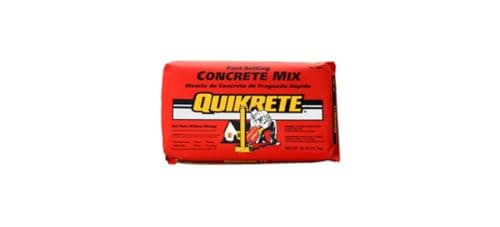
QUIKRETE Concrete Mix (No. 1101), 80 lb
Warranty: not published9.6/100.60 cubic feet per 80-lb bag, 4,000 psi at 28 days, ASTM C387: the mix Goalrilla's guide describes.
See price · Amazon#ad · Price as of November 5, 2026 · Disclosure for the link to QUIKRETE Concrete Mix (No. 1101), 80 lb
Best anchor kit for Goalrilla
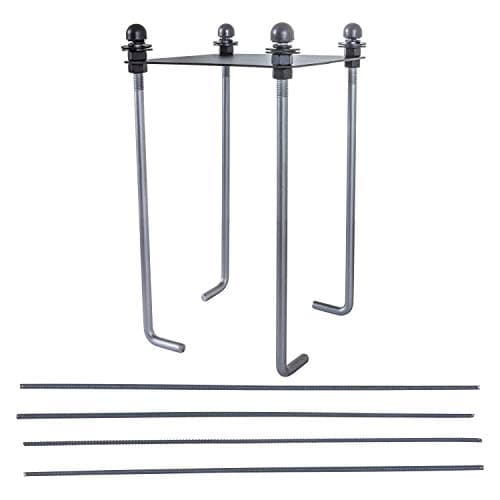
Goalrilla 9" Basketball Hoop Anchor Kit (B1002)
90-day warranty9.4/10The 9-inch plate for the 16x48-inch, eleven-bag hole.
$119.96Amazon#ad · Price as of November 5, 2026 · Disclosure for the link to Goalrilla 9" Basketball Hoop Anchor Kit (B1002)
Best anchor kit for Silverback / Goaliath
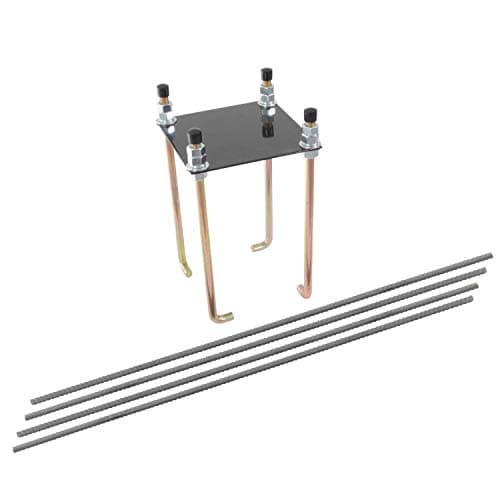
Silverback 7" Basketball Hoop Anchor Kit (B1030)
Warranty: not published9.4/10The 7-inch plate for the 16x36-inch, nine-bag hole.
$89.72Amazon#ad · Price as of November 5, 2026 · Disclosure for the link to Silverback 7" Basketball Hoop Anchor Kit (B1030)
For the same numbers framed as weight rather than bag count — including what a filled portable base comes to — how much does a basketball hoop weigh works both conversions.
How we picked
What earns a pick on this page
Every pick here is built from figures you can check for yourself: the maker's published backboard, pole, overhang and adjustment specs; the hole size, bag count and cure time printed in its install manual; the warranty term in the maker's own wording, exclusions included, with the date we read it; and the failure patterns owners report (base cracking, backboard fogging, two-piece pole lean), which shape the “skip this if” line. Every figure links to where it came from.
Those figures go through one fixed rubric, so an 8.1 here means the same thing as an 8.1 anywhere else on the site and the top pick is the one that earns it for the driveway it is named for. Commissions never set a score or decide a pick. The rubrics and their weights are published.
Questions
Frequently asked
How many bags of concrete for a Goalrilla?
Eleven 80-lb bags per Goalrilla's current installation guide, with 12-13 recommended as a buffer, for a 16-inch by 48-inch hole. The older B1002 anchor manual says nine.
How many bags of concrete for a Silverback or Goaliath?
Nine 80-lb bags per the Silverback SB60 manual, for a 16-inch by 36-inch hole with a 20-inch form at the top, plus four rebar. The Goaliath Ignite and Prodigy use the same 7-inch anchor.
How many bags of concrete for a Lifetime basketball hoop?
Lifetime's guide gives weights: 420-640 lb for in-ground systems (about 5-8 80-lb bags) and 1,040-1,680 lb for bolt-down systems (13-21 bags). Check the manual for your model.
What kind of concrete for a basketball hoop?
Standard bagged concrete mix (Goalrilla asks for ASTM C387; Pro Dunk asks for 3,000 psi or better; QUIKRETE Concrete Mix No. 1101 is 4,000 psi at 28 days). Not mortar, not sand mix. Fast-setting mix is not required by the manuals we read; the 72-hour cure applies either way.
How long does concrete need to cure before mounting a basketball hoop?
A minimum of 72 hours per the Goalrilla and Silverback manuals and Lifetime's guide; Goalrilla recommends mounting on day 5.
Keep reading
Related on Rim & Rebound
- How deep to digThe hole the bags fill.
- How to install an in-ground hoopThe pour, step by step.
- Anchor kits explainedWhy 9-inch and 7-inch anchors take different holes.
- Installation costConcrete is the cheap part.
- Best in-ground hoopsEach card shows its bag count.
- Best concrete for a hoopWhich mix, as opposed to how much.
- What a hoop weighsThe same numbers, as weight.
Receipts
Sources
- QUIKRETE — Concrete Mix No. 1101 data sheet (yields per bag, water, strength; read 2026-09-21)
- QUIKRETE — Concrete Mix (No. 1101) product page (read 2026-09-21)
- Goalrilla — Basketball Hoop Installation guide (read 2026-09-21)
- Goalrilla Anchor Kit B1002 — Anchor System Installation Instructions (PDF hosted by BasketballGoalStore; read 2026-09-21)
- Silverback SB60 (B5402W) owner's manual — anchor installation, assembly and Limited 7 Year Warranty (PDF hosted by Lowe's; read 2026-09-21)
- Lifetime — "Basketball Hoop Assembly: In-Ground and Bolt-Down" (read 2026-09-21)
- Pro Dunk Hoops — THOR Gold (Pro Dunk Gold) product page (read 2026-09-21)
Every figure above is a published one you can click and check. Specs come from the maker's own product pages (linked on every product), install figures from the maker's manual or installation page with the date we read it, and warranty terms from the maker's warranty page or manual. Buy buttons go straight to the current Amazon listing, so the price you see is today's. Where a maker leaves a figure off the page, the card says “not published” rather than guessing. Read how we pick.