#adReader-supported: we may earn a commission if you buy through our links, at no extra cost to you. It never decides a ranking. How we pick · Disclosure
Manual figures as of Sep 21, 2026. Every hole size, bag count and cure time on this page was read from the manufacturer's own install manual or installation page on that date, and each is linked. Makers revise manuals without notice: confirm on the linked page (and the paper manual in your box) before you dig, and tell us if a figure has changed.
Two different weights, and only one of them is useful
“How much does a basketball hoop weigh” is really two questions. The first is what the box weighs — useful on delivery day, and almost never published. The second is what the assembled, ballasted hoop weighs — which is the number that decides whether it stays upright, whether two adults can move it, and whether the slab underneath can take it.
Makers answer the second question, not the first, and they answer it indirectly: base capacity in gallons for a portable, concrete requirement in pounds for an in-ground. Both convert into a real figure with one line of arithmetic.
A filled portable base, worked out
Water weighs 8.34 lb per US gallon. Sand is denser, so a sand-filled base of the same volume lands meaningfully higher — but makers publish the tank volume, not a sand weight, so the water figure is the one that can be quoted honestly.
On top of the ballast sits the hardware: a three-piece steel pole, a steel-framed board and a rim. That is why a filled portable is not something anyone lifts, and why every base has wheels and a tilt point instead. How to move a portable hoop covers the method, and how to fill a base covers sand against water.
An in-ground footing, worked out
An in-ground hoop's weight is almost entirely the footing, and here the makers do publish pounds. Lifetime's 54-inch 90568 and 60-inch 90569 listings both state at least 1,040 lb of concrete mix, 72 hours of curing, 3 to 4 hours of assembly and at least three adults recommended. At 80 lb a bag that is thirteen bags; at 60 lb a bag it is eighteen.
The other brands specify by hole dimension rather than weight. Goalrilla's installation guide calls for 16 inches in diameter by 48 inches deep. The Silverback SB60 manual, which covers Escalade's 7-inch anchor plate, calls for 16 by 36. Converting a hole volume into bags is the job of how much concrete for a hoop, which has the bag counts by brand.
So an in-ground hoop weighs several hundred pounds more than a portable, and all of it is below ground where it does the most good. That — not the pole section — is the real reason in-ground hoops do not move.
Our picks for this
The things that actually carry the weight
Ballast for a portable, mix for a footing, and the best-published base capacity under $300. Every figure links to its source.
Best portable hoop ballast
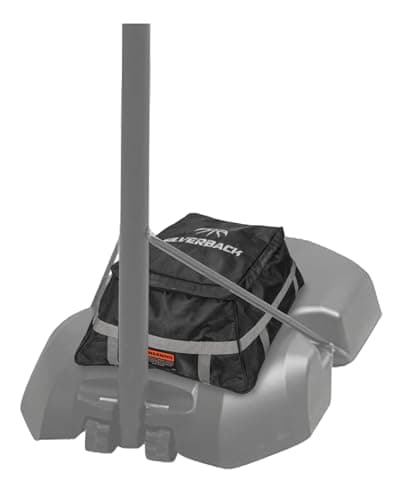
Silverback Portable Basketball Hoop Weight Bag
Warranty: not published8.3/10Up to 100 lb of sand on top of the base — the cheapest way to add weight exactly where it helps.
$49.95Amazon#ad · Price as of November 3, 2026 · Disclosure for the link to Silverback Portable Basketball Hoop Weight Bag
 Stock photo
Best bagged concrete for a hoop footing
QUIKRETE Concrete Mix (No. 1101), 80 lb
Warranty: not published8.9/10The 4,000-psi bagged mix the hoop manuals assume: an 80-lb bag yields about 0.60 cubic feet, takes 6-9 pints of water, and reaches 2,500 psi at 7 days. Buy it locally by the pallet; the link is for the data sheet, not the delivery.
Check price · Amazon#ad · Price as of November 3, 2026 · Disclosure for the link to QUIKRETE Concrete Mix (No. 1101), 80 lb
Best portable under $300
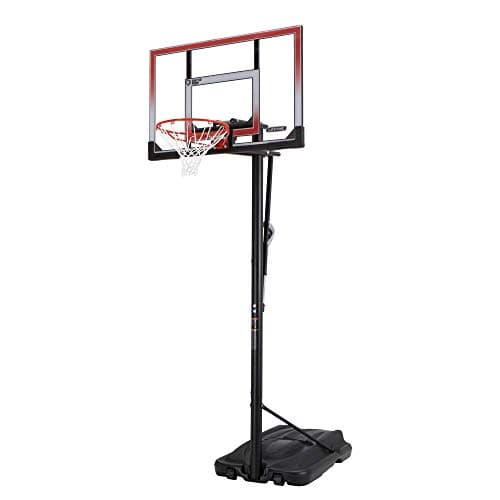
Lifetime 71566 50-Inch XL Base Portable
5-yr warranty6.4/10A published 35-gallon XL base: about 292 lb of water, and the best capacity in its price band.
$457.58Amazon#ad · Price as of November 3, 2026 · Disclosure for the link to Lifetime 71566 50-Inch XL Base Portable
The hardware itself, and why it is rarely published
Very few makers print a shipping or assembled weight for a basketball system, and the ones that hint at it do so through the assembly instruction rather than a number. Lifetime recommends “at least three adults” for its bolt-down systems; the Silverback SB60 manual says four adults on assembly day; Goalrilla says placing the post requires at least four capable adults.
Those recommendations are the practical answer. A 72-inch tempered glass board with its steel frame is a two-person lift at minimum and a four-person job to raise onto a pole. A 44-inch HDPE board is a one-person item. If you need a precise shipping weight — for a freight booking, or a lift — the retailer's listing is the only reliable place to get it, and it varies by packaging.
What the weight actually decides
- Whether the hoop stays up. A half-filled base is the most common cause of a tipped portable. Published capacity is a minimum, not a range. Wind and tipping works through the leverage.
- Whether two people can move it. Up to about 250 lb of ballast, one adult can tilt and walk a base on flat concrete. Past 300 lb it is a two-person job, and across grass it is a drain-first job.
- How many people you need on assembly day. Three to four adults for any in-ground system, per the makers' own instructions. Book them before you pour.
- How much mix to buy. Buy a bag or two more than the calculation, because a hole is never the shape you dug it.
- Nothing about the driveway's structure. A 300 lb base spread over several square feet is less load per square inch than a parked car. A portable hoop will not damage a sound concrete slab.
If the hoop still moves once it is properly ballasted, the cause is somewhere else — how to stop a hoop from shaking works through hardware, footing and pole splices in order.
How we picked
What earns a pick on this page
Every pick here is built from figures you can check for yourself: the maker's published backboard, pole, overhang and adjustment specs; the hole size, bag count and cure time printed in its install manual; the warranty term in the maker's own wording, exclusions included, with the date we read it; and the failure patterns owners report (base cracking, backboard fogging, two-piece pole lean), which shape the “skip this if” line. Every figure links to where it came from.
Those figures go through one fixed rubric, so an 8.1 here means the same thing as an 8.1 anywhere else on the site and the top pick is the one that earns it for the driveway it is named for. Commissions never set a score or decide a pick. The rubrics and their weights are published.
Questions
Frequently asked
How much does a portable basketball hoop weigh when filled?
Water weighs 8.34 lb per US gallon, so a 27-gallon base holds about 225 lb, a 31-gallon base about 259 lb, a 35-gallon base about 292 lb and a 36-gallon base about 300 lb. Sand in the same tank is heavier again. Add the pole, board and rim on top of that, and add 100 lb if you fit a weight bag.
How much concrete does an in-ground basketball hoop need?
Lifetime's 54- and 60-inch bolt-down listings state at least 1,040 lb of concrete mix — thirteen 80-lb bags. Goalrilla specifies the hole instead, at 16 inches by 48 inches deep, which works out to roughly nine to ten 80-lb bags at the 0.6 cubic feet per bag on QUIKRETE's data sheet. Escalade's 7-inch anchor plate wants a 16 by 36 hole, about seven bags.
Can a portable basketball hoop damage my driveway?
A sound concrete slab, no. Three hundred pounds spread across a base several square feet in area is far less load per square inch than a parked car. What does mark a driveway is grit trapped under a base being dragged sideways, and a base left in one spot for years leaving a shadow. Neither is structural.
How many people do you need to assemble a basketball hoop?
For an in-ground system, three to four — and that is the makers' own recommendation, not ours. Lifetime's bolt-down listings say at least three adults and 3 to 4 hours; the Silverback SB60 manual says four adults on assembly day; Goalrilla says placing the post needs at least four capable adults. A portable is a one- or two-person job.
Why don't makers publish the weight of their hoops?
Because the useful number is the ballast, not the hardware, and they publish that instead — base capacity in gallons for a portable, concrete and cure time for an in-ground. A shipping weight varies with packaging and tells a buyer nothing about whether the hoop will stay upright. If you need one for freight, the retailer's listing is the place to look.
Keep reading
Related on Rim & Rebound
Receipts
Sources
- Lifetime — 90040 44-Inch Impact portable hoop product page (read 2026-09-21)
- Lifetime — 71566 50-Inch Polycarbonate Action Grip portable hoop product page (read 2026-09-21)
- ThePortableBasketball.com (Lifetime dealer) — 71566 spec sheet: 35-gallon base, 18" overhang, 6" increments (read 2026-09-21)
- Amazon listing — Lifetime 51550 Portable Basketball Hoop: 48-inch polycarbonate board, Speed Shift 8-10 ft, 31 gal base (live Amazon listing, read 2026-10-04)
- Amazon listing — Lifetime 90168 Portable Basketball Hoop, 48-inch polycarbonate backboard (live Amazon listing, read 2026-10-04)
- Spalding — Momentous Ez Assembly H Frame Portable Basketball Hoop product page (read 2026-09-21)
- Amazon listing — Lifetime 90568 In-Ground 54-Inch Tempered Glass hoop: 3/8 in glass, crank adjust, bolt-down pole and concrete requirement (live Amazon listing, read 2026-10-04)
- Amazon listing — Lifetime 90569 Bolt-Down In-Ground 60-Inch Glass hoop: concrete requirement, crank adjust and Slam-It Ultra rim (live Amazon listing, read 2026-10-04)
- Goalrilla — Basketball Hoop Installation guide (read 2026-09-21)
- Silverback SB60 (B5402W) owner's manual — anchor installation, assembly and Limited 7 Year Warranty (PDF hosted by Lowe's; read 2026-09-21)
- QUIKRETE — Concrete Mix No. 1101 data sheet (yields per bag, water, strength; read 2026-09-21)
- Silverback — Portable Basketball Hoop Weight Bag (B8477W) product page (read 2026-09-21)
- Goalrilla Anchor Kit B1002 — Anchor System Installation Instructions (PDF hosted by BasketballGoalStore; read 2026-09-21)
Every figure above is a published one you can click and check. Specs come from the maker's own product pages (linked on every product), install figures from the maker's manual or installation page with the date we read it, and warranty terms from the maker's warranty page or manual. Buy buttons go straight to the current Amazon listing, so the price you see is today's. Where a maker leaves a figure off the page, the card says “not published” rather than guessing. Read how we pick.