#adReader-supported: we may earn a commission if you buy through our links, at no extra cost to you. It never decides a ranking. How we pick · Disclosure
Manual figures as of Sep 21, 2026. Every hole size, bag count and cure time on this page was read from the manufacturer's own install manual or installation page on that date, and each is linked. Makers revise manuals without notice: confirm on the linked page (and the paper manual in your box) before you dig, and tell us if a figure has changed.
The four causes, and why the order matters
People hear “shaking” and reach for a wrench. Sometimes that works. But a hoop can move for four structurally different reasons, and the fixes range from free to impossible:
- Loose hardware at the backboard, the bracket arms or the pole splices. Free to fix, and worth ruling out first.
- Insufficient ballast in a portable base. Costs a few bags of sand and a weight bag.
- An undersized or green footing under an in-ground pole. Expensive, and the only real fix is a new footing.
- The pole design itself — a two- or three-piece pole flexes at every splice. Not fixable.
Work down that list rather than across it. Most driveway hoops that “shake” are in fact a combination of the first two, which is good news.
1. Hardware: tighten everything, in the right order
Start at the board and work down. The backboard-to-bracket bolts, the bracket-to-pole bolts, the brace arms, the rim bolts and — on a multi-piece pole — the splice hardware. Use a wrench and a socket, not a hand tool, and check the lock nuts rather than just the heads.
Two things matter here. First, hardware loosens on a cycle: every hard shot vibrates the board, and thermal expansion through a summer and a winter works nuts loose. Checking it twice a year is maintenance, not repair. Second, on a bolt-down pole the levelling nuts at the anchor plate can back off, and that makes the entire pole rock on the plate — check those with a spanner and re-plumb the pole against a post level afterward.
2. Ballast: a half-filled base is a moving base
A portable hoop is held up by weight and nothing else. Lifetime's 90040 has a 27-gallon base, the 71566 a 35-gallon XL base, the Spalding Momentous 54 a 36-gallon one. Filled with water, 35 gallons weighs about 290 lb; filled with sand, the same volume is substantially heavier. Half-filled, it is a hoop on a tipping point.
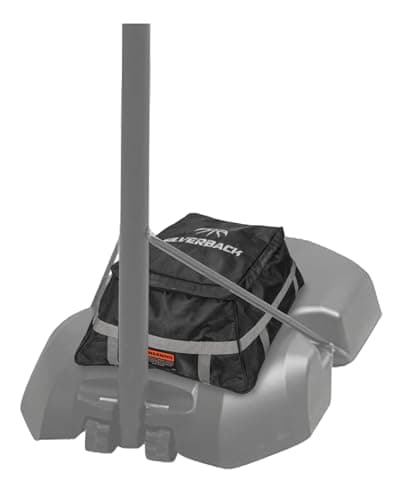
So: top the base off completely, use sand if you can get it in there, and add weight on top. Escalade's universal weight bag holds up to 100 lb of sand and is designed to sit on most portable bases — which is the tidy version of the cinder-block-on-the-base fix. How to fill a portable base has the sand-versus-water numbers, and wind and tipping covers anchoring a portable to the slab.
Our picks for this
What each fix actually needs
Ballast for a portable, the right anchor plate for an in-ground retrofit, and a mix rated for a structural footing. Every spec links to the maker.
Best portable hoop ballast
Silverback Portable Basketball Hoop Weight Bag
Warranty: not published8.3/10Up to 100 lb of sand on top of the base, rated for rain, snow and sun. The fix for a portable that creeps or rocks.
$49.95Amazon#ad · Price as of November 3, 2026 · Disclosure for the link to Silverback Portable Basketball Hoop Weight Bag
Best anchor kit for Silverback / Goaliath
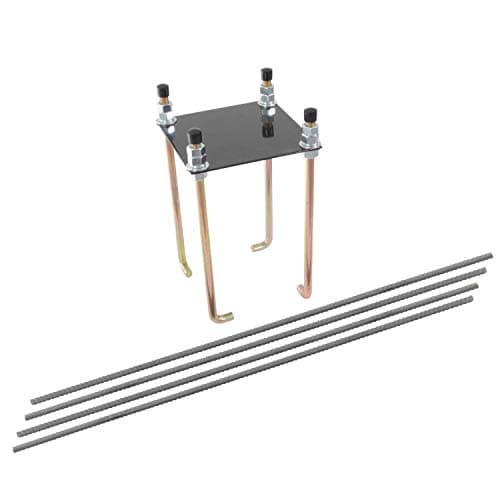
Silverback 7" Basketball Hoop Anchor Kit (B1030)
Warranty: not published8.2/10The 7-inch plate for SB60, SB60 Ghost, SB54, Ignite, Prodigy, SBX60 and SBX54 — buy this if you are re-pouring a footing.
$109.95Amazon#ad · Price as of November 3, 2026 · Disclosure for the link to Silverback 7" Basketball Hoop Anchor Kit (B1030)
 Stock photo
Best for cold weather and fast strength
QUIKRETE 5000 High Early Strength Concrete Mix (No. 1007), 80 lb
Warranty: not published8.6/10The high-early-strength version of the standard mix: 1,500 psi at one day, 5,000 at 28, and a 10-to-12-hour walk-on time. The one to buy when the footing goes in during a cold week or the pole cannot wait three days.
Check price · Amazon#ad · Price as of November 3, 2026 · Disclosure for the link to QUIKRETE 5000 High Early Strength Concrete Mix (No. 1007), 80 lb
3. The footing: compare it to the manual
An in-ground hoop that rocks at the base has a footing problem, and the honest diagnosis is to compare what is in the ground against what the manual asked for. Goalrilla's installation guide specifies 16 inches in diameter by 48 inches deep. The Silverback SB60 manual, which covers Escalade's 7-inch anchor plate, specifies 16 by 36. Lifetime's 54- and 60-inch bolt-down listings state at least 1,040 lb of concrete mix and 72 hours of curing.
If the hole was smaller than that, or the pole was loaded before the concrete cured, the footing is working loose in the soil and tightening bolts will not help. The fix is to break out the footing and re-pour to the manual's dimensions — which, for a bolt-down hoop, means a new anchor kit and another 72-hour wait. How deep to dig has every published depth with its source, and which concrete to use has the strength numbers from the makers' data sheets.
4. The pole itself
If the hardware is tight, the base is full and the footing matches the manual, what is left is the pole. A single-piece pole has nothing to flex at. A two-piece pole has one splice. A three-piece pole has two — and every joint is a place where energy from a hard shot gets absorbed and released as movement you can see.
This is why premium systems advertise “one-piece pole” as a headline. Escalade's Silverback SB54 and SB60 use a single-piece 4x4; the Goalrilla FT line uses one-piece 5x5, 5.5x5.5 and 6x6 sections. Lifetime's glass bolt-down systems use two-piece poles, and its cheaper in-grounds use three. Silverback vs Lifetime is the direct comparison on exactly this spec.
What a retrofit cannot fix
Three things. Pole splices, because the joint is structural. A board mount designed for a cheap hoop, because the bracket arms are the length they are. And a portable base whose published capacity is simply small — 27 gallons will never hold a 54-inch board as steady as 36 will.
If you have worked the list and the hoop still moves more than you can live with, the honest conclusion is that you have the hoop you bought. The specs that buy stillness are a one-piece pole, a big footing and a lot of overhang — best bolt-down hoops ranks the systems that have them, and how long a hoop lasts covers what else goes wrong over a decade.
How we picked
What earns a pick on this page
Every pick here is built from figures you can check for yourself: the maker's published backboard, pole, overhang and adjustment specs; the hole size, bag count and cure time printed in its install manual; the warranty term in the maker's own wording, exclusions included, with the date we read it; and the failure patterns owners report (base cracking, backboard fogging, two-piece pole lean), which shape the “skip this if” line. Every figure links to where it came from.
Those figures go through one fixed rubric, so an 8.1 here means the same thing as an 8.1 anywhere else on the site and the top pick is the one that earns it for the driveway it is named for. Commissions never set a score or decide a pick. The rubrics and their weights are published.
Questions
Frequently asked
Why does my basketball hoop shake so much?
Almost always one of four things: loose bolts at the backboard, bracket or pole splices; a portable base that is not filled to capacity; an in-ground footing smaller than the manual specified, or loaded before it cured; or a multi-piece pole flexing at its joints. Check them in that order — the first two are cheap to fix and the last one cannot be fixed at all.
How do I stop my portable basketball hoop from wobbling?
Fill the base completely, with sand rather than water where you can, and add weight on top — Escalade's universal weight bag takes up to 100 lb of sand and sits on most bases. Then tighten the board, bracket and pole hardware with a wrench. If it still rocks, the base capacity is the limit: a 27-gallon base under a 54-inch board is under-ballasted by design.
Is a shaking backboard dangerous?
A board that vibrates when the ball hits it is normal, especially on polycarbonate. What is not normal is a pole that rocks at the ground line, or visible movement at a bolted joint — both of those get worse with use. Stop playing at full height and deal with the cause before it becomes a failure.
Can I add concrete to an existing footing to stop the shake?
Pouring a collar around an existing footing rarely works, because the new concrete does not bond to the cured old concrete and the original undersized block keeps moving inside it. If the footing is the problem, the fix is to break it out and re-pour to the manual's diameter and depth. For a bolt-down hoop that also means a new anchor kit.
Does a pole pad help with shaking?
No. A pole pad is a safety item — it is there so a player driving the baseline hits foam instead of steel. It adds no stiffness. Buy one anyway if the hoop does not have one, sized to your pole section: pole pads.
Keep reading
Related on Rim & Rebound
- Wind and tippingBallast and anchoring a portable.
- How deep to digThe footing dimensions by brand.
- Best bolt-down hoopsThe systems that do not move.
- How long a hoop lastsWhat else fails, and when.
- How to fill a portable baseSand against water, by weight.
- How to adjust hoop heightWhen the actuator is the loose part.
Receipts
Sources
- Goalrilla — Basketball Hoop Installation guide (read 2026-09-21)
- Silverback SB60 (B5402W) owner's manual — anchor installation, assembly and Limited 7 Year Warranty (PDF hosted by Lowe's; read 2026-09-21)
- Silverback — Portable Basketball Hoop Weight Bag (B8477W) product page (read 2026-09-21)
- Silverback — 7" Basketball Hoop Anchor Kit (B1030) product page (read 2026-09-21)
- QUIKRETE — QUIKRETE 5000 Concrete Mix (No. 1007) product page (read 2026-09-29)
- QUIKRETE — 5000 High Early Strength Concrete Mix (No. 1007) data sheet: strength by age, yields and water (read 2026-09-29)
- Amazon listing — Lifetime 90568 In-Ground 54-Inch Tempered Glass hoop: 3/8 in glass, crank adjust, bolt-down pole and concrete requirement (live Amazon listing, read 2026-10-04)
- Lifetime — 90040 44-Inch Impact portable hoop product page (read 2026-09-21)
- Spalding — Momentous Ez Assembly H Frame Portable Basketball Hoop product page (read 2026-09-21)
- Goalrilla — 180 Breakaway Basketball Rim (B2609W) product page (read 2026-09-21)
Every figure above is a published one you can click and check. Specs come from the maker's own product pages (linked on every product), install figures from the maker's manual or installation page with the date we read it, and warranty terms from the maker's warranty page or manual. Buy buttons go straight to the current Amazon listing, so the price you see is today's. Where a maker leaves a figure off the page, the card says “not published” rather than guessing. Read how we pick.