#adReader-supported: we may earn a commission if you buy through our links, at no extra cost to you. It never decides a ranking. How we pick · Disclosure
Manual figures as of Sep 21, 2026. Every hole size, bag count and cure time on this page was read from the manufacturer's own install manual or installation page on that date, and each is linked. Makers revise manuals without notice: confirm on the linked page (and the paper manual in your box) before you dig, and tell us if a figure has changed.
Measure the rim, not the pole
Rim height is measured from the playing surface directly below the rim to the top of the ring at its front edge. Not to the bottom of the ring, not to the bottom of the backboard, and not up the pole.
Get it right by holding the tape on the slab under the front of the rim and having someone read it at the ring, or by hooking a tape over the front of the ring and letting it fall. Half an inch matters more than people expect: a rim set at 10 feet 6 inches changes the arc a shooter learns, and almost every “my hoop plays wrong” complaint starts here rather than at the backboard. How to measure a basketball backboard covers the board and the bolt pattern the same way.
The five mechanisms, and how each is operated
1. Crank actuator (Escalade: Goalrilla, Goaliath, Silverback)
A removable handle fits onto an all-steel actuator at about waist height on the pole, and turning it drives a screw that swings the extension arms. The Silverback SB60 and SB54 use it through a 7.5-to-10-foot range; the Goaliath Ignite and Prodigy use the same all-steel adjustment; the Goalrilla FT line runs 7.5 to 10 on Goalrilla's Three-Point Technology arms.
Operation: fit the handle fully, turn smoothly, and do not force it past the stops at either end of the range. Escalade sells a locking actuator handle as a replacement part, which tells you how often they go missing.
2. Pump or hydraulic lift (Lifetime 90602, 92139)
A lever is pumped like a car jack and the board rises in infinite increments rather than fixed steps. The Lifetime 90602 is listed with a pump adjust through 7.5 to 10 feet; the 92139 is listed with a hydraulic crank giving infinite increments across the same range.
Operation: short, full strokes rather than long partial ones, and stop as soon as the tape reads the height you want — coming back down is usually slower than going up.
3. One-hand lever (Lifetime Power Lift, Action Grip, Speed Shift)
Lifetime's signature: squeeze a lever and glide, or grip and walk the board up. The 90878 publishes a patented Power Lift through 7.5 to 10 feet in infinite increments; the 71524 is a one-hand Power Lift; the 71566 is Action Grip in six-inch increments; the 51550 is Speed Shift from 8 to 10 feet in six-inch steps; the 90020 is listed as adjusting with one hand.
Operation: one hand on the lever, one on the board frame, and keep the board under control as it moves. These are the easiest systems to actually use, which is the whole point — a height that needs two adults and a tool does not get changed.
4. Telescoping pin (budget portables, Lifetime 90040)
The pole is two tubes with a row of holes; a pin or bolt sets the height. The Lifetime 90040 is listed as telescoping through 7.5 to 10 feet in six-inch increments with no tools.
Operation: this is the one that needs a second person. Support the board's weight, pull the pin, slide to the next hole, let the pin seat fully, and check it is through both tubes before letting go.
5. Broomstick (Lifetime Quick Adjust II, 90168)
The 90168 publishes a Quick Adjust II system running 8 feet to 10 in four-inch increments, operated using a broomstick or post from the ground. Four-inch steps are the finest on this site.
Operation: exactly as listed — a broom handle into the adjustment point, lift, and let it seat. No ladder.
What height to set it to
The NBA and USA Basketball youth standards are the published answer: 6 feet for ages 5 to 6, 8 feet for ages 7 to 8, 9 feet for ages 9 to 11, and 10 feet from 12 up. That means a hoop should move twice in a child's life, at nine and at twelve, and otherwise stay where it is. Hoop height by age has the full table with ball sizes.
Do not set it below the standard on the theory that lower is kinder. A rim below the recommended height lets a child score with a flat two-handed push, which is the habit that has to be unlearned when the rim goes up.
When the mechanism is stiff or stuck
In order of likelihood:
- Corrosion in the screw or the tube. The commonest cause on a hoop that has not moved in two seasons. Clean the exposed thread, apply the lubricant the manual specifies, and work the mechanism through its range a few times rather than forcing it to the far end.
- Load on the arms. An actuator will not move if someone is hanging on the rim or a ball is wedged between board and arm. Obvious, and it happens.
- Grit in a telescoping pole. Portables stored outdoors collect sand in the tube. Drop the pole to its lowest setting, flush it, and dry it before raising it again.
- A bent arm or a failed actuator. If the handle turns freely and nothing moves, or the board drifts down on its own, stop using the hoop at height and contact the maker. Escalade sells replacement actuator handles; a failed actuator itself is a warranty conversation.
Do not add a cheater bar to a crank handle. The handle is sized to the torque the actuator can take, and a longer lever breaks the mechanism rather than the handle.
A lost or broken crank handle
This is the most common adjustment failure on an Escalade hoop, and it has a part number rather than a problem. Escalade sells a Goalrilla replacement actuator handle with a lock, and the same brand sells a Goaliath replacement handle. Buy the one listed for your system rather than a generic crank: the drive is shaped to the actuator.
Fit it, then store it indoors. A handle left on the pole is a handle a neighbour's kid uses to lower the rim to seven feet, and a handle left in the grass is a handle gone.
Hoops that do not adjust at all
Some do not, by design: fixed wall mounts, most over-the-door and mini hoops, and some youth hoops with a short fixed range. If the hoop is fixed at 10 feet and a small child is using it, no mechanism will help — the answer is a second, lower hoop rather than a modification. Best hoops for kids and best mini hoops cover both.
The parts worth having
Our picks for this
One spare part and two hoops that adjust properly
If adjustment is the feature you actually use, these are the published systems worth owning, plus the part most likely to go missing.
 Stock photo
Best replacement crank handle (Goalrilla)
Goalrilla Replacement Actuator Handle with Lock
Warranty: not published9.3/10The replacement crank handle with a lock, for Goalrilla and Goaliath actuators. The single most-lost part on an in-ground hoop.
Not sold on Amazon
Goalrilla sells this direct, through its own dealers. We have no affiliate relationship there and do not link it as a buy button; the specs above cite its page as a source.
Best hoop for the 8-foot-basket years
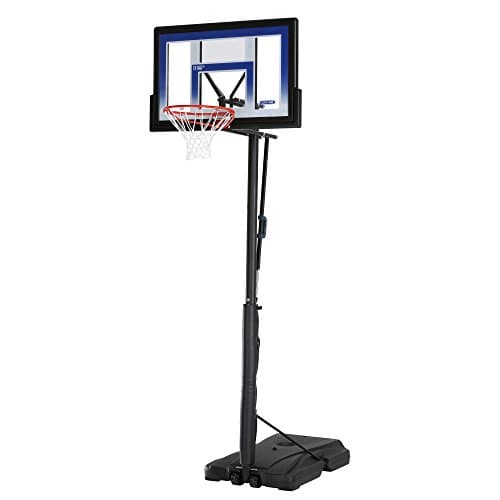
Lifetime 51550 48-Inch Speed Shift Portable
5-yr warranty7.7/10Speed Shift in six-inch steps from exactly 8 feet to 10: the published youth standard at the bottom of its range.
$269.00Amazon#ad · Price as of November 3, 2026 · Disclosure for the link to Lifetime 51550 48-Inch Speed Shift Portable
Best portable overall
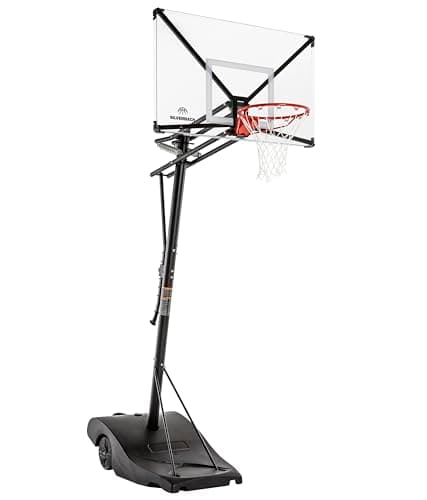
Silverback NXT 54 Portable
Warranty: not published7.9/10Escalade's updated actuator through 7.5 to 10 feet in six-inch increments, on a portable you can also move.
$549.95Amazon#ad · Price as of November 3, 2026 · Disclosure for the link to Silverback NXT 54 Portable
How we picked
What earns a pick on this page
Every pick here is built from figures you can check for yourself: the maker's published backboard, pole, overhang and adjustment specs; the hole size, bag count and cure time printed in its install manual; the warranty term in the maker's own wording, exclusions included, with the date we read it; and the failure patterns owners report (base cracking, backboard fogging, two-piece pole lean), which shape the “skip this if” line. Every figure links to where it came from.
Those figures go through one fixed rubric, so an 8.1 here means the same thing as an 8.1 anywhere else on the site and the top pick is the one that earns it for the driveway it is named for. Commissions never set a score or decide a pick. The rubrics and their weights are published.
Questions
Frequently asked
How do you measure basketball hoop height correctly?
From the playing surface directly beneath the rim to the top of the ring at its front edge. Not the bottom of the ring and not the bottom of the backboard. Regulation is 10 feet; half an inch of error changes the arc a shooter learns.
How low does an adjustable basketball hoop go?
Almost every Escalade, Lifetime and Spalding system stops at 7.5 feet. The exceptions are the specialist makers: Goalsetter publishes 6 feet on the MVP 72 and All-American 60 and 6 feet 8 inches on the X554, Mega Slam and Pro Dunk both publish 5 feet, and the Dominator 72 publishes 7 feet.
What do I do if the crank handle is missing?
Buy the replacement listed for your system rather than a generic crank — Escalade sells a Goalrilla locking actuator handle and a Goaliath replacement handle, because the drive is shaped to the actuator. Then store it indoors.
Why won't my basketball hoop adjust?
Most often corrosion in the actuator screw or grit in a telescoping pole, after a season or two without moving. Clean and lubricate per the manual and work it gently through the range. If the handle turns freely with no movement, or the board drifts down on its own, stop using the hoop at height — that is a failed actuator, not a maintenance job. Never add a cheater bar to the handle.
What height should the hoop be for my child?
Per the NBA and USA Basketball youth standards: 6 feet for ages 5 to 6, 8 feet for 7 to 8, 9 feet for 9 to 11 and 10 feet from 12. That is two height changes across a childhood. Setting it lower than the standard encourages a flat chest push rather than a shooting motion.
Keep reading
Related on Rim & Rebound
Receipts
Sources
- Goalrilla — Replacement Actuator Handle with Lock (B2633W-1) product page (read 2026-09-21)
- Goalrilla — FT60 product page (read 2026-09-21)
- Silverback — SB60 product page (read 2026-09-21)
- Silverback — SB54 product page (read 2026-09-21)
- Silverback — NXT 54 Portable product page (read 2026-09-21)
- Escalade Sports — NXT 54-Inch Portable Basketball Goal (B8401W) product page (read 2026-09-21)
- Goaliath — Ignite 60" product page (read 2026-09-21)
- Goaliath — Prodigy 54" product page (read 2026-09-21)
- Amazon listing — Lifetime 90602 In-Ground 54-Inch Tempered Glass hoop: pump adjust, 3-piece pole and 27 in overhang (live Amazon listing, read 2026-10-04)
- Amazon listing — Lifetime NBA 92139 Bolt-Down In-Ground 60-Inch Glass hoop: tempered glass, hydraulic crank and Slam-It Ultra rim (live Amazon listing, read 2026-10-04)
- Amazon listing — Lifetime 90878 Power Lift In-Ground hoop: 54-inch acrylic board, Power Lift adjustment and Slam-It Pro rim (live Amazon listing, read 2026-10-04)
- Amazon listing — Lifetime 51550 Portable Basketball Hoop: 48-inch polycarbonate board, Speed Shift 8-10 ft, 31 gal base (live Amazon listing, read 2026-10-04)
- Amazon listing — Lifetime 90168 Portable Basketball Hoop, 48-inch polycarbonate backboard (live Amazon listing, read 2026-10-04)
- Lifetime — 90040 44-Inch Impact portable hoop product page (read 2026-09-21)
- ThePortableBasketball.com (Lifetime dealer) — 71566 spec sheet: 35-gallon base, 18" overhang, 6" increments (read 2026-09-21)
- Goalsetter — MVP Adjustable Basketball Hoop product page (read 2026-09-21)
- Amazon listing — Goalsetter X554 Extreme Series In-Ground hoop (ES45654A3): 54-inch glass, 5" pole, adjustment range and extension (live Amazon listing, read 2026-10-04)
- Mega Slam Hoops — Mega Slam 60 detailed specifications (read 2026-09-21)
- Pro Dunk Hoops — THOR Gold (Pro Dunk Gold) product page (read 2026-09-21)
- NBA / USA Basketball — age-appropriate rules and standards for youth basketball (basket height and ball size by age; read 2026-09-21)
Every figure above is a published one you can click and check. Specs come from the maker's own product pages (linked on every product), install figures from the maker's manual or installation page with the date we read it, and warranty terms from the maker's warranty page or manual. Buy buttons go straight to the current Amazon listing, so the price you see is today's. Where a maker leaves a figure off the page, the card says “not published” rather than guessing. Read how we pick.