#adReader-supported: we may earn a commission if you buy through our links, at no extra cost to you. It never decides a ranking. How we pick · Disclosure
The measurement that counts
Basketball backboards are sold on one dimension: width. A “54-inch hoop” means a board 54 inches across. Nobody in the industry quotes the board's height in its product name, and most makers do not publish a height figure at all at the small sizes — which is itself a useful signal about what tier a board is in.
So the measurement you need is the horizontal one, across the front face, at the widest point. On a framed board — steel-framed polycarbonate, or tempered glass fused to a steel frame — measure to the outer edges of the frame, because that is what the maker counted. On a bare HDPE or acrylic board, measure the panel.
Taking it, step by step
- Lower the rim if the hoop adjusts. Almost every driveway hoop crank or lift goes down to 7.5 feet. Take the measurement at the lowest setting so you are not working at arm's length on a ladder.
- Run the tape horizontally across the front face, roughly level with the top of the rim, from one outer edge to the other. Keep the tape flat against the board rather than bowed out.
- Read to the nearest half inch and round to the nearest standard size. Boards are not precise to the inch — a nominal 54 may read 53 3/4 or 54 1/2.
- Measure the height the same way, vertically down the centre of the face, and note it.
- Measure the rim bolt pattern — centre to centre, horizontally and vertically, on the four bolts that hold the rim to the board. That is the number that decides what rim fits.
The standard sizes, and what each one is
| Width | Board either side of an 18 in rim | What it usually is |
|---|---|---|
| 44 in | 13 in | Entry portable; HDPE or polycarbonate, often a static rim |
| 48 in | 15 in | Step-up portable; the smallest board sold as an in-ground system |
| 50 in | 16 in | Narrow-driveway portables; where glass first appears |
| 54 in | 18 in | The one-car-driveway size; tempered glass becomes normal |
| 60 in | 21 in | The two-car-driveway size; glass on 4x4 and 5x5 poles |
| 72 in | 27 in | Regulation width; needs about 30 ft of playable slab to use |
A rim is 18 inches across, so the “board either side” column is simply (width − 18) ÷ 2 — and it is the figure that actually describes what you can bank a shot off. The backboard size guide matches each size to a driveway, 44 vs 48 compares the two starter sizes, and 54 vs 60 vs 72 compares the three driveway sizes.
The rim bolt pattern is the measurement that decides what fits
If the reason you are measuring is a bent rim, the board width matters less than the bolt pattern. Rim mounts are not universal, and the three common patterns do not interchange:
- About 2-7/8 by 2-1/2 inches: the common bracket Spalding's Slam Jam rim is built for — the universal-fit upgrade for a budget portable's static rim.
- 4x4 inches: Escalade's Silverback and Goaliath boards, served by the Silverback standard and deluxe breakaway rims.
- 5x5 inches: the glass Goalrillas, served by the heavy-weight and 180 rims.
Measure centre to centre on both axes before ordering. Better still, read the model number off the board or the pole label, because Goalrilla and Silverback publish explicit fit lists by model — the Goalrilla heavy-weight rim lists DC72E1, CV72, CV60, GS72c, FT72, FT60 and FT54, and the Silverback standard rim lists every NXT, GoTek and SBX system. Replacement rims has the fit lists in one place.
Our picks for this
What the measurement tells you to buy
Measure the bolt pattern, then buy the rim that matches it. Nets are the one part that is genuinely near-universal.
Best universal breakaway rim
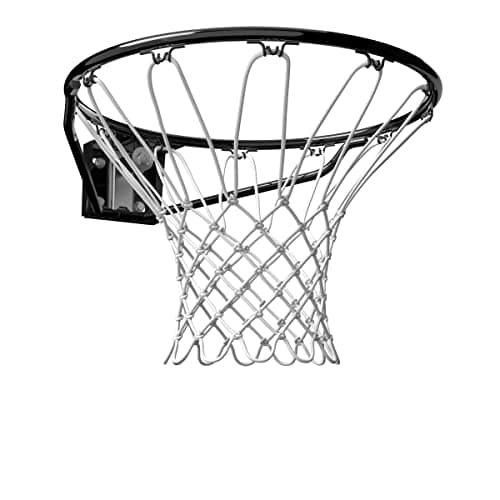
Spalding Slam Jam Basketball Rim
1-yr warranty7.9/10The universal-fit breakaway for the common 2-7/8 x 2-1/2 inch bracket — the upgrade for a static rim.
$79.75Amazon#ad · Price as of November 3, 2026 · Disclosure for the link to Spalding Slam Jam Basketball Rim
Best OEM replacement (Goalrilla FT/CV)
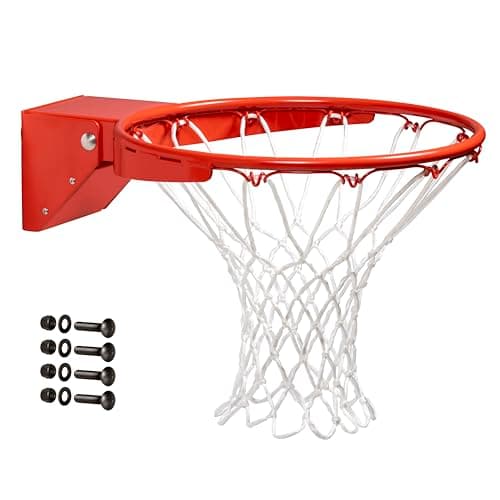
Goalrilla Heavy-Weight Breakaway Rim
Warranty: not published7.1/10The OEM replacement for the glass Goalrillas, with the model fit list published on the product page.
$199.99Amazon#ad · Price as of November 3, 2026 · Disclosure for the link to Goalrilla Heavy-Weight Breakaway Rim
Best replacement net
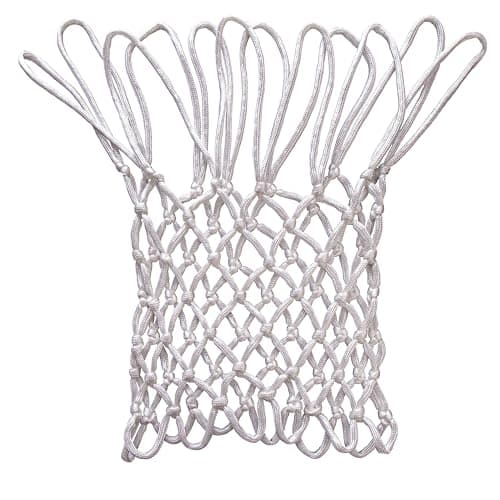
Goalrilla All-Weather Nylon Basketball Net
Warranty: not published8.6/10Fits all Goalrilla, Silverback and Goaliath rims. A net is sized by the rim, not the board.
$14.95Amazon#ad · Price as of November 3, 2026 · Disclosure for the link to Goalrilla All-Weather Nylon Basketball Net
Height and thickness, and why makers hide them
Board height matters as much as width for a bank shot, and almost nobody publishes it at 44 and 48 inches. At 54 inches and up the figures start appearing: the Silverback SB54 is quoted as 54 x 33, the SB60 as 60 x 33, a Goalrilla FT60 board as 60 x 38. A board 38 inches tall gives a materially bigger target than one 33 inches tall at the same width.
Thickness is the glass spec. Three-eighths of an inch is the figure the serious boards publish — Goalrilla's FT line, Lifetime's Mammoth and its 90568 and 90569 glass systems. Measure it at the edge with a rule if you want to know what you have. Glass vs acrylic vs polycarbonate explains what the material and the thickness do to a rebound.
Why you are measuring, and what to do next
There are really only four reasons to measure a backboard, and each one points somewhere different:
- Replacing a rim or a net. Measure the bolt pattern, not the board. Nets are near-universal; rims are not.
- Buying a backboard pad. Pads are sold by board width, so the width figure is exactly what you need.
- Working out whether to upgrade. Compare your number against the table above and against the playable width of the slab. Where to put a hoop covers measuring the driveway itself.
- Selling or listing the hoop. Quote width first, then material, then rim type. That is the order buyers search in.
One thing measuring will not tell you: the rim height. That is set by the hoop's adjustment and should be measured from the playing surface to the top of the rim — 10 feet for regulation. Hoop height by age has the youth standard, setting by setting.
How we picked
What earns a pick on this page
Every pick here is built from figures you can check for yourself: the maker's published backboard, pole, overhang and adjustment specs; the hole size, bag count and cure time printed in its install manual; the warranty term in the maker's own wording, exclusions included, with the date we read it; and the failure patterns owners report (base cracking, backboard fogging, two-piece pole lean), which shape the “skip this if” line. Every figure links to where it came from.
Those figures go through one fixed rubric, so an 8.1 here means the same thing as an 8.1 anywhere else on the site and the top pick is the one that earns it for the driveway it is named for. Commissions never set a score or decide a pick. The rubrics and their weights are published.
Questions
Frequently asked
How do you measure a basketball backboard?
Measure the width across the front face at its widest point, in inches, including the steel frame if the board is framed. That horizontal figure is what every maker and every listing means by board size. Lower the rim to its minimum setting first, keep the tape flat against the face, and round your reading to the nearest standard size: 44, 48, 50, 54, 60 or 72 inches.
Is a backboard measured in width or diagonally?
Width. Unlike a television, a backboard is never quoted diagonally. A 54-inch board is 54 inches across the face. Its height is a separate figure, often around 33 inches at that width, and many makers do not publish it at all on the smaller boards.
What is the standard basketball backboard size?
Regulation is 72 inches wide by 42 inches high. On driveways the common sizes are 44, 48, 50, 54, 60 and 72 inches, and 54 and 60 are what most households buy — 54 for a one-car slab, 60 for two. A 54-inch board leaves 18 inches either side of an 18-inch rim.
How do I know what size rim fits my backboard?
Measure the four rim bolts centre to centre, horizontally and vertically. About 2-7/8 by 2-1/2 inches is the common bracket that Spalding's Slam Jam fits; 4x4 is Escalade's Silverback and Goaliath pattern; 5x5 is the glass Goalrillas. Better still, find the model number on the pole or board — Goalrilla and Silverback publish fit lists by model on their rim pages.
How do you measure backboard thickness?
With a rule against the exposed edge of the panel. On tempered glass the figure the serious makers publish is 3/8 inch — Goalrilla's FT line, Lifetime's Mammoth and its 90568 and 90569 glass systems all quote it. Acrylic and polycarbonate boards are usually thinner and rarely published at all.
Keep reading
Related on Rim & Rebound
- Backboard size guideEvery size matched to a driveway.
- 44 vs 48 inch backboardThe two starter sizes compared.
- 54 vs 60 vs 72 backboardThe three driveway sizes compared.
- Replacement rimsBolt patterns and fit lists.
- Glass vs acrylic vs polycarbonateWhat the material does to a rebound.
- How to adjust hoop heightMeasuring the rim, not the pole.
- How to replace a rimWhere the bolt pattern you measured goes.
Receipts
Sources
- Lifetime — "Basketball Backboards: The Lifetime Complete Guide" (read 2026-09-21)
- Spalding — Slam Jam Basketball Rim product page (read 2026-09-21)
- Goalrilla — Heavy-Weight Breakaway Rim (B2600) product page (read 2026-09-21)
- Silverback — Standard Breakaway Rim (B2617W) product page (read 2026-09-21)
- Goalrilla — All-Weather Nylon Basketball Net (B2602W) product page (read 2026-09-21)
- Goalrilla — FT60 product page (read 2026-09-21)
- Silverback — SB54 product page (read 2026-09-21)
- Silverback — SB60 product page (read 2026-09-21)
- Amazon listing — Lifetime 90568 In-Ground 54-Inch Tempered Glass hoop: 3/8 in glass, crank adjust, bolt-down pole and concrete requirement (live Amazon listing, read 2026-10-04)
- NBA / USA Basketball — age-appropriate rules and standards for youth basketball (basket height and ball size by age; read 2026-09-21)
Every figure above is a published one you can click and check. Specs come from the maker's own product pages (linked on every product), install figures from the maker's manual or installation page with the date we read it, and warranty terms from the maker's warranty page or manual. Buy buttons go straight to the current Amazon listing, so the price you see is today's. Where a maker leaves a figure off the page, the card says “not published” rather than guessing. Read how we pick.