#adReader-supported: we may earn a commission if you buy through our links, at no extra cost to you. It never decides a ranking. How we pick · Disclosure
The table
| Tempered glass | Acrylic | Polycarbonate | |
|---|---|---|---|
| Rebound | Gym-like; the standard the others are measured against | Below glass, above polycarbonate | Softer; absorbs energy |
| Impact | Can break under a hard object; excluded from Lifetime's warranty | Tougher than glass; can crack under a severe hit | Does not crack or chip (Lifetime); stronger than acrylic |
| Scratching | Very resistant | Scratches; retains clarity longer than polycarbonate | Scratches easily; cannot be polished out |
| Sun and weather | Unaffected | Can yellow and haze over years | Yellows and fogs over years |
| Cold | Unaffected | Fine in cold | Fine in cold; more brittle in extreme cold than at room temperature |
| Weight | Heaviest; needs the biggest pole | Light | Light |
| Price band | Highest | Middle | Lowest (in-ground) or middle (portable) |
| Found on | Goalrilla, Silverback SB/SBX, Goaliath Ignite/Prodigy, Lifetime 90014 and Mammoth, Spalding 888 and Beast | Spalding U-Turn, Momentous; Goalsetter and Beast options; Lifetime 78888 | Silverback NXT, Goaliath GoTek, Lifetime 90698, 71524, 71566 |
The rebound, impact and scratch rows draw on Lifetime's backboard guide (tempered glass has an “amazing rebound factor,” polycarbonate surfaces “do not crack or chip” and are “stronger even than acrylic,” Impact HDPE has a “lower rebound factor”) and on the makers' product pages; the sun and scratching rows are what owners of acrylic and polycarbonate boards commonly report after years outdoors, stated as reported rather than measured.
Tempered glass
A sheet of glass 5/16 to 1/2 inch thick, heat-treated so it breaks into pebbles rather than shards, in a steel or aluminum frame. It is what gyms use, and every maker's premium line is glass: Goalrilla at 3/8 inch, Silverback and Goaliath at 5/16, Pro Dunk and Mega Slam at 1/2. It rebounds hardest and most consistently, never yellows, and barely scratches. Its two costs are weight, which is why glass boards ride on 4x4-to-6x6 poles and portables built for glass (the Lifetime Mammoth, Spalding Beast) have metal-framed or 55-gallon bases, and breakage: Lifetime's warranty terms exclude “breakage of the tempered glass playing surface,” while Goalrilla's GS-series pages say their lifetime term includes the glass and Mega Slam offers a one-time backboard replacement. Read the term before assuming.
Acrylic
A clear plastic sheet with the look of glass, lighter, tougher than glass under impact, and cheaper. Spalding builds its U-Turn in-ground and Momentous portables around it; Goalsetter and Spalding's Beast offer it as an alternative to glass. It rebounds better than polycarbonate and worse than glass, and it can scratch; what owners most commonly report after several years outdoors is yellowing and haze, which changes the look more than the play. On a budget in-ground with a ground sleeve or a fast-assembling portable, acrylic is a reasonable middle.
Polycarbonate (and HDPE)
The unbreakable one. Polycarbonate is what Lifetime calls shatterproof and what Escalade uses on its NXT and GoTek lines; it takes a bat, a rock from the mower or a fall in a storm without cracking. The trade is a softer rebound (the sheet flexes and absorbs the ball) and a surface that scratches and fogs over years and cannot be polished back. High-density polyethylene (Lifetime's Impact boards on 44-inch hoops) is a step further in the same direction: unbreakable, cheap, and with what Lifetime itself calls a lower rebound factor that suits “children and beginning players.”
Which one for your driveway
Our picks for this
One in-ground per material
Three Amazon-sold in-grounds, one per board material, so the trade is concrete. Specs link to the makers.
Best in-ground under $1,200
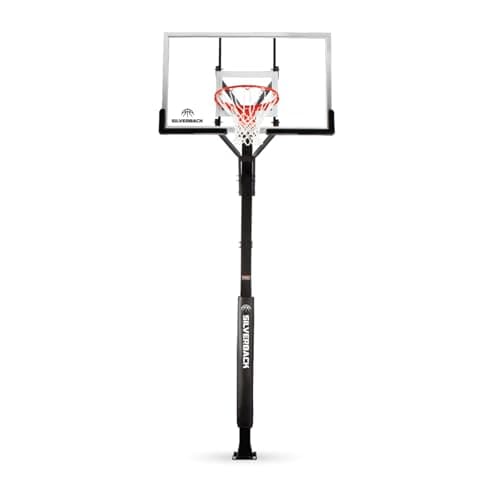
Silverback SB60
5-yr warranty9.1/10Tempered glass at 5/16 inch, 60 inches, on a single-piece 4x4 with pads in the box.
$1,099.95Amazon#ad · Price as of November 5, 2026 · Disclosure for the link to Silverback SB60
Best acrylic in-ground
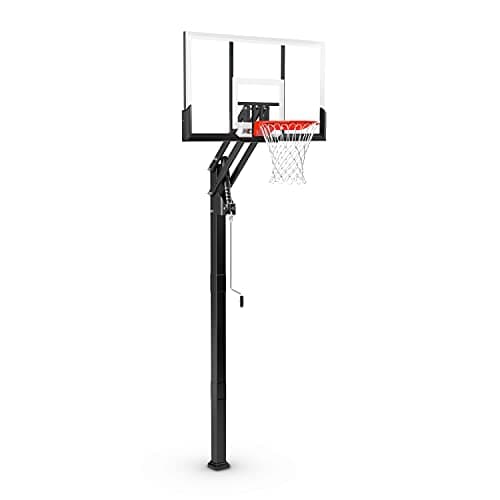
Spalding Acrylic U-Turn 54-Inch In-Ground
1-yr warranty8.6/10Acrylic, 54 inches, on a 4-inch pole in a ground sleeve; one-year Spalding term.
$854.65Amazon#ad · Price as of November 5, 2026 · Disclosure for the link to Spalding Acrylic U-Turn 54-Inch In-Ground
Best 60-inch in-ground under $800
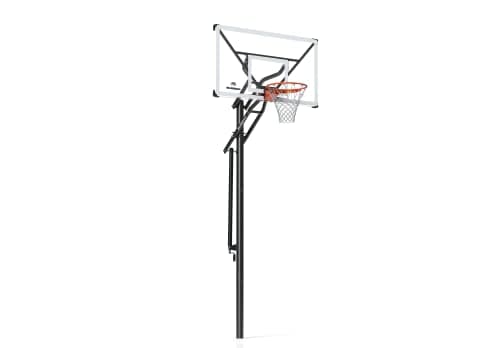
Silverback NXT 60 In-Ground
5-yr warranty8.8/10Polycarbonate, 60 inches, direct-bury round pole; the cheapest 60-inch in-ground here.
$769.95Amazon#ad · Price as of November 5, 2026 · Disclosure for the link to Silverback NXT 60 In-Ground
How we picked
What earns a pick on this page
Every pick here is built from figures you can check for yourself: the maker's published backboard, pole, overhang and adjustment specs; the hole size, bag count and cure time printed in its install manual; the warranty term in the maker's own wording, exclusions included, with the date we read it; and the failure patterns owners report (base cracking, backboard fogging, two-piece pole lean), which shape the “skip this if” line. Every figure links to where it came from.
Those figures go through one fixed rubric, so an 8.1 here means the same thing as an 8.1 anywhere else on the site and the top pick is the one that earns it for the driveway it is named for. Commissions never set a score or decide a pick. The rubrics and their weights are published.
Questions
Frequently asked
Is polycarbonate or acrylic better for a basketball backboard?
Polycarbonate for impact resistance (Lifetime says it does not crack or chip and is stronger than acrylic); acrylic for rebound and clarity. Both scratch and yellow over years outdoors; polycarbonate more so.
Is a tempered glass backboard worth it?
For teenagers and adults, yes: it rebounds like a gym and stays clear for the life of the hoop. It can break under a hard impact and needs a bigger pole. For kids under 12 on a driveway with bats and a mower, polycarbonate is the sensible choice.
Does a polycarbonate backboard hold up in the cold?
Polycarbonate is used outdoors year-round by every maker here and is rated for it. Like most plastics it is more brittle in extreme cold than at room temperature; the practical failure owners report is scratching and fogging from sun, not cold.
Do glass backboards break?
Tempered glass breaks under a hard, fast impact from an object (a bat, a rock, a fall), not from basketballs. Lifetime excludes glass breakage from its warranty; Goalrilla's GS-series pages say its lifetime term includes the glass; Mega Slam offers a one-time replacement.
Keep reading
Related on Rim & Rebound
- Backboard size guideSize first, then material.
- 54 vs 60 vs 72 backboardThe three full sizes.
- Best in-ground hoops under $1,000Glass vs polycarbonate at the same price.
- Best outdoor hoopsWeather resistance by material.
- Best hoops for kidsWhere polycarbonate is the right answer.
- 44 vs 48 inch backboardWhere plastic boards are the only option.
Receipts
Sources
- Lifetime — "Basketball Backboards: The Lifetime Complete Guide" (read 2026-09-21)
- Lifetime — FAQ: "What is the warranty period on a Lifetime basketball system?" (read 2026-09-21)
- Amazon listing — Silverback Ghost 60" Height Adjustable In-Ground Basketball Hoop (B5409W): tinted glass, actuator and included pads (live Amazon listing, read 2026-10-04)
- Mega Slam Hoops — Mega Slam 72 product page (read 2026-09-21)
- Silverback — SB60 product page (read 2026-09-21)
- Spalding — Acrylic U-Turn In-Ground Basketball Hoop product page (read 2026-09-21)
- Spalding — Warranty Information (basketball systems: 1-year limited; read 2026-09-21)
- Silverback — NXT 60 In Ground product page (read 2026-09-21)
- Amazon listing — Lifetime 90878 Power Lift In-Ground hoop: 54-inch acrylic board, Power Lift adjustment and Slam-It Pro rim (live Amazon listing, read 2026-10-04)
- Lifetime — 90698 54-Inch Polycarbonate Power Lift in-ground hoop product page (read 2026-09-21)
- Lifetime — 90040 44-Inch Impact portable hoop product page (read 2026-09-21)
- Pro Dunk Hoops — THOR Gold (Pro Dunk Gold) product page (read 2026-09-21)
Every figure above is a published one you can click and check. Specs come from the maker's own product pages (linked on every product), install figures from the maker's manual or installation page with the date we read it, and warranty terms from the maker's warranty page or manual. Buy buttons go straight to the current Amazon listing, so the price you see is today's. Where a maker leaves a figure off the page, the card says “not published” rather than guessing. Read how we pick.