#adReader-supported: we may earn a commission if you buy through our links, at no extra cost to you. It never decides a ranking. How we pick · Disclosure
The method, in four steps
- Lower the rim to its minimum. Almost every portable here drops to 7.5 feet; the Lifetime 90168 stops at 8. This drops the centre of gravity and gets the board out of tree branches and garage headers.
- Clear the path. Ten feet of board sweeping through a doorway or past a car mirror is how boards get cracked.
- Tilt the base forward onto its wheels. Take the pole just below the board with both hands and pull back until the base pivots onto the wheels and the kickstand or rear foot lifts clear.
- Walk it. Keep the tilt shallow — just enough to clear the back of the base — and push rather than drag. Two people is comfortable; one is possible on a small base and a flat slab.
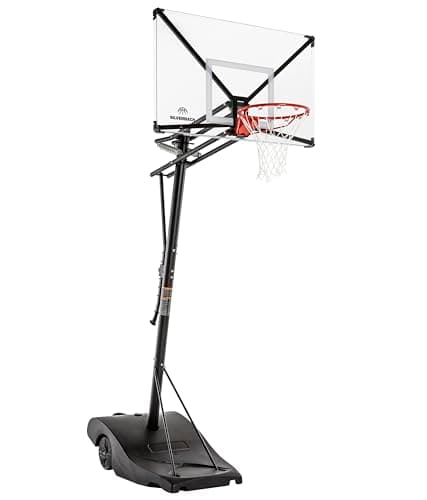
That is it, for the ninety per cent of moves that happen on concrete. The makers build for this: Escalade publishes “large weighted wheels, ErgoMove wheelbarrow-style tilt, rear kickstand” on the NXT 54, Lifetime's 90040 lists built-in wheels on its 27-gallon Pro Court base, and the NXT 50's page says the base tilts forward onto its wheels and is movable by two people.
Lower the rim first, every time
This is the step people skip and regret. A 54-inch board at 10 feet, tilted back on a base, is a long lever with a lot of mass at the top of it. Lowered to 7.5 feet the same hoop is noticeably easier to balance and far less likely to run the board into something.
If the hoop has a crank actuator, wind it all the way down and leave the handle on. If it has a one-hand lift (Lifetime's Power Lift, Action Grip, Speed Shift), drop it to the bottom detent. If it is a telescoping pole with pins, pull the pins and collapse it.
Tilt and walk, done properly
Grip the pole with both hands at roughly chest height — not on the board, and not on the rim. Pull back smoothly; the base will pivot up onto the wheels with far less effort than its weight suggests, because the wheels sit close to the base's centre of mass by design.
Keep the tilt as shallow as will clear the ground. A steep tilt puts the mass further over the wheels and makes the hoop want to keep going. If the base starts to run away downhill, let it come back down flat — that is what the kickstand is for.
Across grass, gravel and a lip
This is where filled bases stop being easy. Base wheels are small and hard, and a lawn offers no rolling resistance relief at all: a 290 lb base sinks in, the wheels stop turning and you end up dragging.
Three things help. Lay planks or plywood as a track and roll along them. Pick a dry day, because a wet lawn is both softer and more easily damaged. And for a significant distance across soft ground, drain a water base first — it is quicker than fighting it.
For a step or a driveway lip, approach square-on rather than at an angle, and lift the base over with a second person taking the weight at the back. Rolling a loaded base diagonally over a lip is how the wheel axle housings break.
When draining is the right call
- A long move, or across soft ground. Anything beyond about fifty feet of lawn.
- Loading into a truck or trailer. Nobody lifts a 300 lb base. Drain, disassemble the pole if the manual allows, and load the base, pole and board separately.
- Before winter, if the base holds water. Freezing water is what splits bases — winter storage covers it.
To drain water: unscrew the fill cap, tip the base toward the opening and let it run, or siphon it with a hose if the hoop cannot be tilted. A sand-filled base is a different proposition — wet sand has to be scooped out through the cap with a scoop or a shop vac, which takes an hour or two and is the real cost of choosing sand. How to fill a portable base has the sand-against-water trade in full.
Our picks for this
The portables that actually move, and the ballast to add once they stop
Base weight is what you are pushing, so the lighter bases move easiest and need the most help standing still. Every spec links to the maker's page.
Best portable under $200
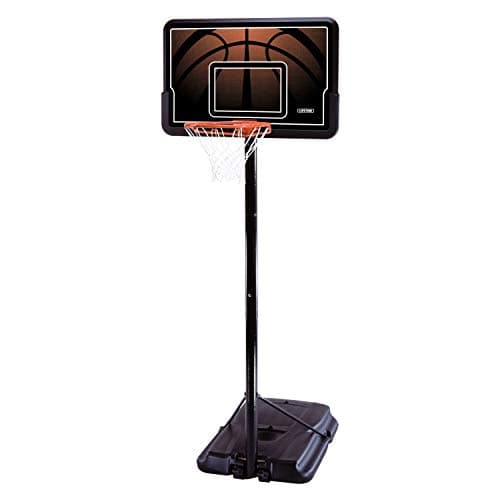
Lifetime 90040 44-Inch Impact Portable
5-yr warranty5.7/10A 27-gallon base with built-in wheels: the easiest portable here to move, and the lightest.
Check price · Amazon#ad · Price as of November 3, 2026 · Disclosure for the link to Lifetime 90040 44-Inch Impact Portable
Best portable under $300
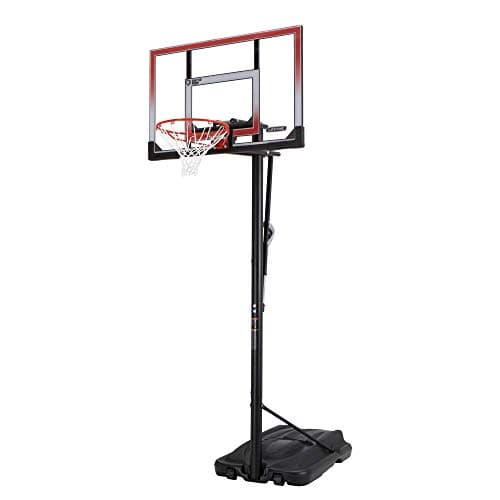
Lifetime 71566 50-Inch XL Base Portable
5-yr warranty6.4/10A 35-gallon XL base on wheels — more ballast to push, and more stability once it is parked.
$457.58Amazon#ad · Price as of November 3, 2026 · Disclosure for the link to Lifetime 71566 50-Inch XL Base Portable
Best portable overall
Silverback NXT 54 Portable
Warranty: not published7.9/10Large weighted wheels, a wheelbarrow-style tilt and a rear kickstand, on the portable that plays best.
$549.95Amazon#ad · Price as of November 3, 2026 · Disclosure for the link to Silverback NXT 54 Portable
Best portable hoop ballast
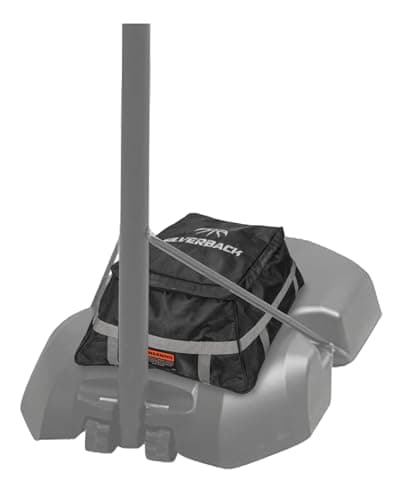
Silverback Portable Basketball Hoop Weight Bag
Warranty: not published8.3/10Up to 100 lb of sand that lifts off before a move and goes back on after it. The movable way to add weight.
$49.95Amazon#ad · Price as of November 3, 2026 · Disclosure for the link to Silverback Portable Basketball Hoop Weight Bag
Moving house with a portable hoop
Drain the base completely, then take the hoop back to three parts: base, pole sections and board. Most portables come apart in reverse of their assembly order, and the assembly manual is the instruction set for it — Lifetime's and Escalade's are published online if the paper one is long gone.
Keep the hardware bagged and labelled by step. The single most common problem with a reassembled portable is a missing bolt from the pole-to-base joint, which is exactly the joint that cannot be improvised. Transport the board flat and padded, face up.
What breaks a base
- Dragging it sideways when loaded. The wheel housings are moulded into the plastic and that is the load they are not designed for.
- Stacking blocks on it. Point loads crack a moulded tank over a season. Use a weight bag, which spreads the load.
- Leaving water in it through a freeze. The expansion has to go somewhere, and it goes through the wall.
- Moving it at full height. Not a base failure, a board failure — but the most expensive one.
If the hoop has to go in and out often enough that this is a weekly job, the honest answer may be a different hoop. A wall mount uses no floor at all and never needs moving: best wall-mounted hoops, or best hoops for a small driveway for the whole decision.
How we picked
What earns a pick on this page
Every pick here is built from figures you can check for yourself: the maker's published backboard, pole, overhang and adjustment specs; the hole size, bag count and cure time printed in its install manual; the warranty term in the maker's own wording, exclusions included, with the date we read it; and the failure patterns owners report (base cracking, backboard fogging, two-piece pole lean), which shape the “skip this if” line. Every figure links to where it came from.
Those figures go through one fixed rubric, so an 8.1 here means the same thing as an 8.1 anywhere else on the site and the top pick is the one that earns it for the driveway it is named for. Commissions never set a score or decide a pick. The rubrics and their weights are published.
Questions
Frequently asked
How do you move a portable basketball hoop by yourself?
Lower the rim all the way, clear the path, grip the pole at chest height and tilt the base back onto its wheels, then walk it like a wheelbarrow. One adult can manage a 27- or 31-gallon base on a flat slab. A 35-gallon-plus base filled with sand is a two-person job, and anything across grass needs planks or a second pair of hands.
Do you have to drain a portable basketball hoop to move it?
No, not for a normal move across a driveway — the wheels and tilt point exist precisely so you do not have to. Drain it for a long move, a move across soft ground, loading into a vehicle, or before a freeze. A sand-filled base is much harder to empty than a water-filled one, which is worth knowing before you choose the fill.
Can you move a portable basketball hoop across grass?
With difficulty. Small hard wheels sink into a lawn and a filled base stops rolling and starts dragging. Lay plywood or planks as a track, choose a dry day, and for anything beyond about fifty feet drain a water base first. Dragging a loaded base across grass damages both the lawn and the wheel housings.
Where do you grip a portable hoop to move it?
The pole, with both hands, at about chest height. Not the rim — every maker excludes rim-hanging from its warranty and a breakaway rim is not a handle. Not the backboard edge either, because on a framed board the frame joint is the weak point and on a glass board it is the glass.
How heavy is a portable basketball hoop base?
Filled with water, about 225 lb for a 27-gallon base, 259 lb for 31 gallons, 292 lb for 35 gallons and 300 lb for 36 gallons, at 8.34 lb per US gallon. Sand is heavier again. Add the pole, board and rim on top of that — which is why the tilt-and-wheel method, rather than lifting, is the only sensible way to move one.
Keep reading
Related on Rim & Rebound
Receipts
Sources
- Lifetime — 90040 44-Inch Impact portable hoop product page (read 2026-09-21)
- Lifetime — 71566 50-Inch Polycarbonate Action Grip portable hoop product page (read 2026-09-21)
- ThePortableBasketball.com (Lifetime dealer) — 71566 spec sheet: 35-gallon base, 18" overhang, 6" increments (read 2026-09-21)
- Lifetime — 71524 54-Inch Polycarbonate Power Lift portable hoop product page (read 2026-09-21)
- Silverback — NXT 54 Portable product page (read 2026-09-21)
- Silverback — NXT 50 Portable product page (read 2026-09-21)
- Silverback — Portable Basketball Hoop Weight Bag (B8477W) product page (read 2026-09-21)
- Amazon listing — Lifetime 90168 Portable Basketball Hoop, 48-inch polycarbonate backboard (live Amazon listing, read 2026-10-04)
- Lifetime — FAQ: "What is the warranty period on a Lifetime basketball system?" (read 2026-09-21)
Every figure above is a published one you can click and check. Specs come from the maker's own product pages (linked on every product), install figures from the maker's manual or installation page with the date we read it, and warranty terms from the maker's warranty page or manual. Buy buttons go straight to the current Amazon listing, so the price you see is today's. Where a maker leaves a figure off the page, the card says “not published” rather than guessing. Read how we pick.