#adReader-supported: we may earn a commission if you buy through our links, at no extra cost to you. It never decides a ranking. How we pick · Disclosure
Manual figures as of Sep 21, 2026. Every hole size, bag count and cure time on this page was read from the manufacturer's own install manual or installation page on that date, and each is linked. Makers revise manuals without notice: confirm on the linked page (and the paper manual in your box) before you dig, and tell us if a figure has changed.
What overhang is, and what it is not
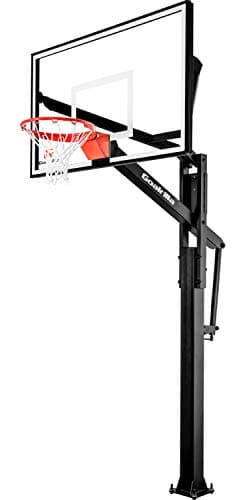
Overhang — also published as offset, extension or “pole to board” — is the horizontal distance from the front of the pole to the front of the backboard. It is not the distance from the pole to the rim's centre, and it is not how far the pole sits back from the court line. Makers measure it pole-face to board-face, and that is the number to compare.
The reason it matters is geometry under the basket. On a 10-foot rim the board is vertical and the rim projects about 15 inches forward of it, so a player going up for a layup finishes a couple of feet in front of the board. Overhang is what puts the pole behind all of that instead of in the middle of it.
Every published overhang figure on this site
- 4 feet — Goalrilla FT72 (published as a maximum), Goalsetter MVP 72, Mega Slam 72, Pro Dunk Gold (48 inches at a 10-foot rim), Dominator 72 (held at every height).
- 3.5 feet — Goalrilla FT60, published as a maximum.
- 3 feet — Goalsetter All-American 60, published as an extension from the pole to the front of the board.
- 3 feet at 10 feet, growing to 4 feet 4 inches at 7.5 — Mega Slam 60, which publishes the full curve: 36 inches at 10 ft, 52 inches at 7.5 ft, 48 inches at 5 ft.
- 2.5 feet — Goalsetter X554; Silverback SB60, whose manual gives the more precise figure of 27 inches at a 10-foot rim height.
- 27 inches — Lifetime 90602 54-inch glass in-ground, which is one of the few Lifetime systems to publish an overhang at all.
- 2 feet — Silverback SB54, Goaliath Ignite 60, Goaliath Prodigy 54.
- Not published — most Lifetime systems, including the 92139 60-inch bolt-down and the 90878 54-inch power lift, and almost every portable.
How much you actually need
For a residential driveway, the useful bands are these.
- 2 feet. Playable. A straight-on jump shot is unaffected, and the rim is clear. But a drive from either baseline finishes close to the pole, which is why hoops in this band ship pole pads or badly need them. If the hoop is at the top of a short driveway and most play is shooting rather than driving, two feet is fine.
- 2.5 to 3 feet. The right target for most families. Enough clearance that a layup finishes in air rather than at the post, and achievable on a 16-inch footing with nine to eleven bags of mix.
- 3.5 to 4 feet. Competition geometry. Genuinely better, and genuinely only usable if the playable width and depth are there — on a 20-foot driveway a 4-foot overhang mostly moves the pole into the grass and the board over the slab edge.
Portables are a separate conversation: the base itself sits forward of the pole and is the obstacle, not the column. Makers almost never publish an overhang for a portable because the base dimensions are what you have to plan around. In-ground vs portable covers that difference, and wind and tipping explains why the base is where it is.
Why the number moves as the rim is raised and lowered
Nearly every adjustable in-ground hoop works the same way: the board hangs on a pair of extension arms, and changing the height swings those arms through an arc. The board therefore moves forward and back as it moves up and down, and the overhang a maker publishes is a snapshot — almost always the maximum, at the top of the range.
Mega Slam is the one brand here that publishes the whole curve on its 60-inch system, and it is instructive: 36 inches at a 10-foot rim, 52 inches at 7.5 feet, 48 inches at 5 feet. The overhang grows as the rim comes down. Pro Dunk publishes the same behaviour: 48 inches at 10 feet, 56 at 8, 65 at 6.
The practical consequence: a hoop set at 8 feet for a child has a different footprint than the same hoop at 10. If you are siting the footing against a garage or a fence, plan for the position you will actually use most. The Dominator 72 is the exception on this site — it telescopes rather than pivots, so its listing claims four feet at every height; Goalrilla vs Dominator works through what that is worth against everything else the listing does not publish.
What more overhang costs
Overhang is a lever, and a longer lever puts more bending moment into the pole and the footing. That is why the hoops with four feet of it also have the biggest poles and the biggest holes: Goalrilla's FT line wants a 16-inch hole 48 inches deep with eleven 80-lb bags, Pro Dunk specifies a 20-inch-square hole 3 feet deep with 15 to 20 bags, and the 2-foot-overhang Escalade systems on the 7-inch plate want a 16 by 36 hole and nine bags.
So more overhang means more concrete, a heavier pole, a higher price and a bigger dig. It also means more clearance behind the pole is needed, because the board sits further forward of it — the Silverback SB60 manual specifies 18 inches of minimum rear clearance behind the pole, which is the kind of figure that catches people installing against a fence. How much concrete has every published bag count.
Measuring your own driveway for it
Do this with a tape before ordering, not after. Stand where the pole will go and measure forward along the driveway: you want the published overhang plus at least 4 feet of landing space in front of the board before you hit a slope, a kerb or a parked car. Then measure behind the pole for the maker's rear clearance. Then measure side to side, because board width is the other half of this — 54 vs 60 vs 72 inches has the widths and where to put a hoop in your driveway covers siting, slope and the 811 call.
Hoops that publish a real overhang figure
Our picks for this
Three hoops with published overhang, one per band
Each of these states its overhang on the maker's own page, which is more than most of the category manages. Pick the band your driveway can actually use.
Best for a two-car driveway
Goalrilla FT60
Limited lifetime warranty8.6/103.5 feet maximum: the most overhang on a 60-inch board here, on a 5.5x5.5 one-piece pole with a limited lifetime term. Wants a 48-inch footing.
$2,379.75Amazon#ad · Price as of November 3, 2026 · Disclosure for the link to Goalrilla FT60
Best American-made in-ground
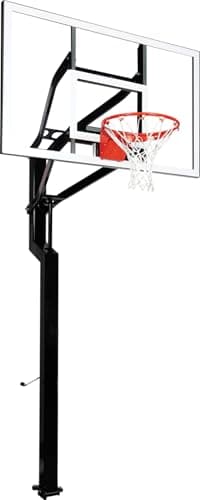
Goalsetter All-American 60
5-yr warranty8.7/103 feet of extension on a one-piece offset 5-inch pole, with the wall gauge published and a rim that drops to 6 feet.
$2,599.99Amazon#ad · Price as of November 3, 2026 · Disclosure for the link to Goalsetter All-American 60
Best in-ground under $1,200
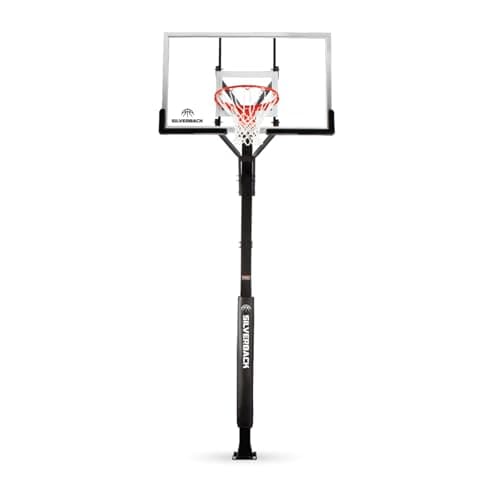
Silverback SB60
5-yr warranty7.3/102.5 feet on the page, 27 inches at a 10-foot rim in the manual. The honest mid-band figure, on a nine-bag footing with both pads included.
$1,099.95Amazon#ad · Price as of November 3, 2026 · Disclosure for the link to Silverback SB60
How we picked
What earns a pick on this page
Every pick here is built from figures you can check for yourself: the maker's published backboard, pole, overhang and adjustment specs; the hole size, bag count and cure time printed in its install manual; the warranty term in the maker's own wording, exclusions included, with the date we read it; and the failure patterns owners report (base cracking, backboard fogging, two-piece pole lean), which shape the “skip this if” line. Every figure links to where it came from.
Those figures go through one fixed rubric, so an 8.1 here means the same thing as an 8.1 anywhere else on the site and the top pick is the one that earns it for the driveway it is named for. Commissions never set a score or decide a pick. The rubrics and their weights are published.
Questions
Frequently asked
How much should a basketball hoop overhang?
For a residential driveway, 2.5 to 3 feet is the right target: enough that a baseline drive finishes in air rather than at the pole, without demanding a competition-sized footing. Two feet is playable if most play is shooting. Four feet is a competition figure that only pays off on a playable width of roughly 30 feet.
What does basketball hoop overhang mean?
The horizontal distance from the front face of the pole to the front of the backboard. Makers also call it offset or extension. It is measured pole-face to board-face, not pole to rim centre.
Does the overhang change when you adjust the height?
On almost every adjustable in-ground hoop, yes. The board hangs on extension arms that swing through an arc, so the published figure is usually the maximum at the top of the range. Mega Slam publishes the whole curve on its 60-inch system — 36 inches at 10 feet, 52 at 7.5, 48 at 5 — and Pro Dunk publishes 48 inches at 10 feet growing to 65 at 6. A telescoping pole holds the figure constant instead.
Is 2 feet of overhang enough?
It is enough for shooting and workable for most family play, and it is what the glass Silverback SB54 and both Goaliath glass in-grounds publish. What it is not enough for is a hard baseline drive, which is why hoops in this band either ship a pole pad or badly want one.
Why does more overhang need a bigger footing?
Because overhang is a lever. A board four feet forward of the pole puts far more bending moment into the column and the concrete than one two feet forward. That is why the four-foot hoops specify the biggest holes — Pro Dunk wants a 20-inch-square hole three feet deep with 15 to 20 bags — and the two-foot Escalade systems get away with 16 by 36 and nine bags.
Keep reading
Related on Rim & Rebound
Receipts
Sources
- Goalrilla — FT60 product page (read 2026-09-21)
- Goalrilla — FT72 product page (read 2026-09-21)
- Goalrilla — Basketball Hoop Installation guide (read 2026-09-21)
- Amazon listing — Goalsetter All-American In-Ground System, 60-inch glass (SS45560G2): pole gauge, adjustment range, backboard and extension (live Amazon listing, read 2026-10-04)
- Amazon listing — Goalsetter X554 Extreme Series In-Ground hoop (ES45654A3): 54-inch glass, 5" pole, adjustment range and extension (live Amazon listing, read 2026-10-04)
- Goalsetter — MVP Adjustable Basketball Hoop product page (read 2026-09-21)
- Silverback — SB60 product page (read 2026-09-21)
- Silverback SB60 (B5402W) owner's manual — anchor installation, assembly and Limited 7 Year Warranty (PDF hosted by Lowe's; read 2026-09-21)
- Silverback — SB54 product page (read 2026-09-21)
- Goaliath — Ignite 60" product page (read 2026-09-21)
- Goaliath — Prodigy 54" product page (read 2026-09-21)
- Amazon listing — Lifetime 90602 In-Ground 54-Inch Tempered Glass hoop: pump adjust, 3-piece pole and 27 in overhang (live Amazon listing, read 2026-10-04)
- Mega Slam Hoops — Mega Slam 60 detailed specifications (read 2026-09-21)
- Mega Slam Hoops — Mega Slam 72 product page (read 2026-09-21)
- Pro Dunk Hoops — THOR Gold (Pro Dunk Gold) product page (read 2026-09-21)
- Amazon listing — Dominator 72" In-Ground Basketball Hoop: aluminium backboard, telescoping 7-10 ft adjustment and constant 4 ft overhang (live Amazon listing, read 2026-10-04)
Every figure above is a published one you can click and check. Specs come from the maker's own product pages (linked on every product), install figures from the maker's manual or installation page with the date we read it, and warranty terms from the maker's warranty page or manual. Buy buttons go straight to the current Amazon listing, so the price you see is today's. Where a maker leaves a figure off the page, the card says “not published” rather than guessing. Read how we pick.