#adReader-supported: we may earn a commission if you buy through our links, at no extra cost to you. It never decides a ranking. How we pick · Disclosure
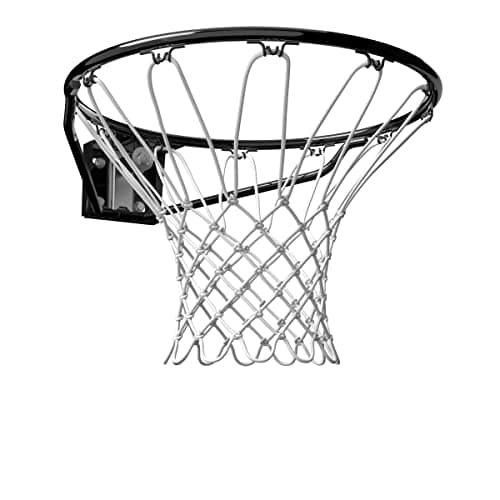
The four types, and why the difference is not cosmetic
A basketball rim looks like a simple part and it is doing more work than almost anything else on a hoop. Every missed shot loads it, every rebound rattles it, and in a driveway with teenagers something will eventually hang off it. The four types below differ in exactly one respect — what happens to the ring when load comes down on the front of it — and that single difference decides how the hoop plays, how long the backboard survives, and whether the warranty is still worth anything.
This page is the taxonomy. If you already know you want a breakaway and just need the binary case for it, breakaway rim vs standard rim is that argument. If you have decided to swap one, how to replace a basketball rim covers measuring the bolt pattern and the job itself, and best replacement basketball rims is the ranked shortlist.
1. Static rims (also sold as “standard” or “fixed”)
A single steel ring welded to a flat mounting plate, bolted to the backboard. Nothing moves. This is what comes on most hoops under about $200, on nearly every over-the-door and mini hoop, and on a lot of older playground installations.
How it plays: hard. The ball comes off a static ring faster and more unpredictably than off a sprung one, because none of the energy goes into a spring. Shots that would rattle in on a breakaway rim bounce out.
The real problem: steel that yields once yields again at lower load. A static rim that has been hung on stays bent, and a bent rim cannot be straightened reliably — the metal is permanently weaker at the point it folded. On a cheap hoop that is a $20 part; on a glass backboard the bigger risk is the load path into the board itself.
Where it is still the right answer: mini hoops, toddler hoops, and anything a player under about eight will use. Nobody is dunking on a 6-foot rim, and a static ring is cheaper and has nothing to wear out. Best mini basketball hoops and best hoops for toddlers are where this type belongs.
2. Double-ring static rims
The same fixed design with a second steel ring welded beneath the first. The second ring is pure stiffness — it resists the ring folding without adding any give. These are common on institutional and park hoops, and they appear on some premium residential systems as the shipped rim.
Goalsetter's All-American 60, for example, lists a double static rim as standard and sells a heavy-duty breakaway separately, which is worth knowing before you buy a four-figure hoop expecting a breakaway in the box. We flag the same thing on Goalsetter vs Lifetime.
How it plays: harder still than a single static ring. Very durable, very unforgiving, and exactly what a public court wants because it survives abuse from strangers.
The catch: durability of the rim is not the same as protection for the backboard. A rigid ring transmits a dunk straight into the board and its mount. That is the entire reason breakaway rims were invented.
3. Single-pivot spring breakaway rims
A ring on a hinged bracket with one or two compression springs behind it. Load past a threshold and the front of the ring drops; release it and the spring snaps the ring back to level. This is the workhorse type and it is what the great majority of driveway hoops ship.
The language varies by brand and all of it means the same mechanism. Lifetime calls its versions Slam-It, Slam-It Pro and Slam-It Ultra and publishes “double compression springs” with a wraparound steel brace on the upper models. Escalade publishes a Medium-Weight Breakaway on the glass Silverback and Goaliath systems and a Heavy-Weight Breakaway on the Goalrilla FT and CV line — the FT60 review covers what that rim does and does not buy you on a four-figure hoop. Spalding sells the Slam Jam and Pro Slam with “ultra-smooth spring breakaway action”. Mega Slam publishes a Collegiate Flex rim described as single-pivot and rated at 1,100 lb of torque on its 60-inch spec page.
How it plays: softer and more forgiving. Shots rattle in more often, and the rim absorbs the shock of a rebound instead of passing it to the board.
The limitation, and it is the reason type 4 exists: a single-pivot rim flexes in essentially one direction — downward and forward. A player who comes in from the side and hangs will load the ring in a direction the hinge was not designed for.
4. 180-degree breakaway rims
A breakaway that flexes front-to-back and side-to-side. Goalrilla's product page for its 180 Breakaway Rim describes “180 degrees of flex action” in both planes, with no ram's horn and a recessed net.
This is the type a house with dunkers wants, and it is priced accordingly: Goalrilla lists the 180 well above its own heavy-weight replacement rim, which is a portable hoop's worth of money for a rim. It also fits only Goalrilla's 5 x 5 bolt pattern — the DC72E1, CV72, CV60, GS72c, FT72, FT60 and FT54.
How it plays: the most forgiving of the four, and the only one that behaves predictably when the load comes in off-axis.
The catch: cost and fitment, plus a detail that catches people out — a recessed-net rim does not take a standard twelve-loop net. Goalrilla sells a dedicated 180 Breakaway Net and Cable replacement for it, which how to put a net on a hoop covers.
What basketball rims are made of
Essentially all of them are steel, and the published differences are in the ring diameter, the tube thickness and the finish rather than the base material.
- Ring stock. Solid or hollow steel tube, formed into an 18-inch-diameter ring — the regulation inside diameter, which every rim on this site matches. Lifetime describes its Slam-It as a “solid-steel” rim with welded net hooks.
- Bracket and hardware. Goalrilla publishes “all-steel strength, stainless steel components, powder coat finish” on its heavy-weight and medium-weight rims, and Escalade publishes the same on the Silverback Standard. Stainless hardware is the part that matters outdoors, because the bolts and spring pins rust long before the ring does.
- Finish. Powder coat on every rim here. It is a film, so it chips, and a chipped rim rusts at the chip. Hoop rust prevention covers keeping on top of that.
What is not published anywhere, by anyone: ring wall thickness. Several listings on this site say so explicitly — the Spalding Slam Jam and Pro Slam pages publish no ring thickness or diameter figure. If a page quotes you a tube gauge for a residential rim, ask where it came from.
How the net attaches, which is its own small taxonomy
Three styles, and they are not interchangeable.
- Welded hooks. Twelve small steel hooks welded around the ring. Any standard twelve-loop net fits. This is the great majority of residential rims.
- Drilled holes. Twelve holes rather than hooks, common on budget and static rims. A standard net still fits; the loop is girth-hitched through the hole instead of hung on a hook.
- Recessed net and cable. The net sits in a channel and is held by a cable, with no exposed hooks — a safety feature on rims designed to be hung on. Goalrilla's 180 uses this, and it needs the maker's net-and-cable kit rather than a loop net.
A related piece of jargon: a ram's horn is the curled bracket that carries the net on some older rim designs. Goalrilla lists “no ram's horn” as a feature of the 180 precisely because that bracket is what fingers catch on.
How to tell which type you have, in thirty seconds
- Look behind the ring, where it meets the board. Visible coil springs and a hinged bracket mean a breakaway. A flat plate with four bolts and no springs means static.
- If it has springs, push down on the front of the ring. If it gives and snaps back, it is a working breakaway. If it does not move under hand pressure, that is normal — the threshold is well above arm strength on a heavy-weight rim.
- Push sideways on the ring. Side-to-side give as well as downward give is a 180-degree rim. Most people will find none.
- Count the rings. Two concentric rings, no springs, is a double-ring static.
- Look at the net. Twelve hooks or holes means a conventional rim. A net sitting in a channel with no visible hooks is a recessed-net rim.
While you are up there with a ladder, measure the four mounting holes center to center — that pattern, not the rim type, is what decides which replacement will fit. How to measure a basketball backboard covers taking that measurement properly.
Which type should you buy?
Static or double-ring static: only for mini hoops, toddler hoops and anything a child under about eight uses. Cheaper, nothing to wear out, and nobody is loading it.
Single-pivot breakaway: the right answer for almost every driveway. It is what the mid-price and premium hoops ship, it costs around $90 to $220 as a replacement depending on the bolt pattern, and upgrading a budget hoop's static ring to one is the single biggest change you can make to how a driveway hoop plays.
180-degree breakaway: buy it if somebody in the house genuinely dunks, you own a glass Goalrilla with the 5 x 5 pattern, and you accept that it costs more than some complete portable hoops. Check the warranty position first, because a 180 rim does not by itself make hanging a covered activity.
One rim per type
Our picks for this
A rim for each type and bolt pattern
Fitment decides this more than type does, so each of these is matched to a published bolt pattern. Measure your four mounting holes center to center before ordering any of them.
Best universal breakaway rim
Spalding Slam Jam Basketball Rim
1-yr warranty7.9/10Single-pivot spring breakaway on the small 2-7/8 x 2-1/2 in universal bracket: the upgrade for a budget portable's static ring, around $100 with a net.
$79.75Amazon#ad · Price as of November 3, 2026 · Disclosure for the link to Spalding Slam Jam Basketball Rim
Best pro-style breakaway rim
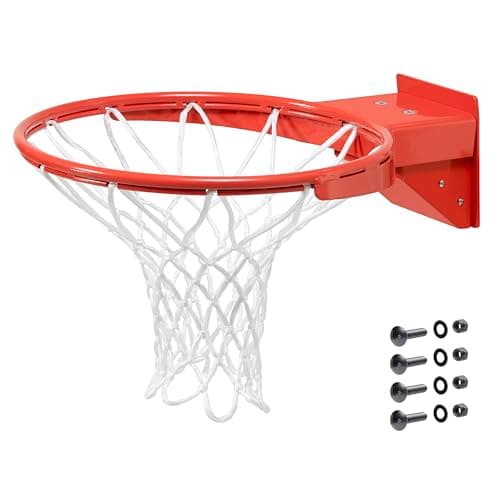
Goalrilla 180 Breakaway Rim
Warranty: not published7.7/10The 180-degree type: flexes front-to-back and side-to-side, no ram's horn, recessed net. Goalrilla 5x5 pattern only, and it takes its own net-and-cable kit.
$299.95Amazon#ad · Price as of November 3, 2026 · Disclosure for the link to Goalrilla 180 Breakaway Rim
Best replacement rim for Silverback / Goaliath glass hoops
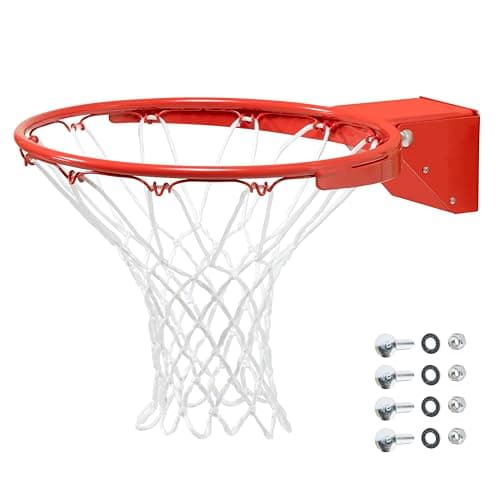
Goalrilla Medium-Weight Breakaway Rim
Warranty: not published7.8/10Single-pivot breakaway on the 3x4 / 4x4 pattern: the OEM part for a glass Silverback, Goaliath Ignite or Prodigy, or a Goalrilla GS.
$159.95Amazon#ad · Price as of November 3, 2026 · Disclosure for the link to Goalrilla Medium-Weight Breakaway Rim
Best replacement rim for NXT / GoTek
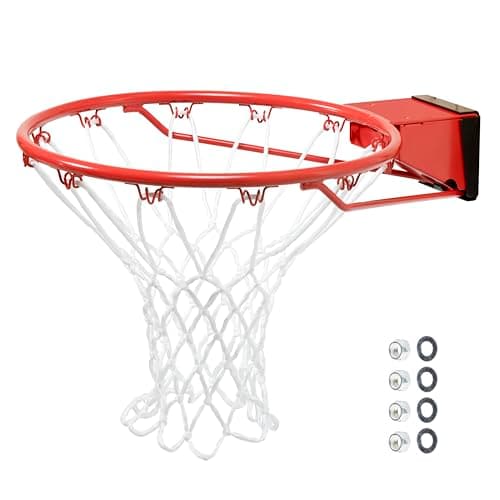
Silverback Standard Breakaway Rim
Warranty: not published7.6/10Single-pivot breakaway on Escalade's polycarbonate pattern (NXT, GoTek, SBX): the cheapest brand-correct breakaway here, with a net included.
$89.95Amazon#ad · Price as of November 3, 2026 · Disclosure for the link to Silverback Standard Breakaway Rim
How we picked
What earns a pick on this page
Every pick here is built from figures you can check for yourself: the maker's published backboard, pole, overhang and adjustment specs; the hole size, bag count and cure time printed in its install manual; the warranty term in the maker's own wording, exclusions included, with the date we read it; and the failure patterns owners report (base cracking, backboard fogging, two-piece pole lean), which shape the “skip this if” line. Every figure links to where it came from.
Those figures go through one fixed rubric, so an 8.1 here means the same thing as an 8.1 anywhere else on the site and the top pick is the one that earns it for the driveway it is named for. Commissions never set a score or decide a pick. The rubrics and their weights are published.
Questions
Frequently asked
What are the different types of basketball rims?
Four, on residential hoops: static (a fixed ring, no springs), double-ring static (a second ring welded beneath for stiffness, still fixed), single-pivot spring breakaway (flexes down and forward, then snaps back), and 180-degree breakaway (flexes front-to-back and side-to-side). The difference between them is only what the ring does under load, and that one difference decides how the hoop plays and whether the backboard takes the shock.
What are basketball rims made of?
Steel, essentially always, formed into an 18-inch-diameter ring. The published differences are in the bracket and hardware rather than the ring: Goalrilla and Silverback both publish all-steel construction with stainless steel components and a powder-coat finish, and Lifetime describes its Slam-It as solid steel with welded net hooks. Ring wall thickness is not published by any maker on this site — Spalding's own pages state no ring diameter or thickness figure.
How do I know if my basketball rim is a breakaway?
Look behind the ring where it meets the backboard. Visible coil springs and a hinged bracket mean a breakaway; a flat plate with four bolts and no springs means static. If it has springs but will not move under hand pressure, that is normal — the breakaway threshold on a heavy-weight rim is well above arm strength.
Is a double rim worse than a single rim?
It is harder to score on and more durable, which is why park and institutional hoops use it. A double-ring static rim adds stiffness, not give, so it transmits a dunk straight into the backboard and its mount. For a driveway where someone will hang on the rim, a breakaway is the better choice; for a public court that has to survive strangers, the double ring is.
Does a breakaway rim mean I can dunk on my hoop?
Not by itself. Goalrilla's warranty sheet states that rims are not warranted for defects other than workmanship and that hanging on the rim voids the warranty, on hoops that ship a heavy-weight breakaway rim. Mega Slam and Pro Dunk are the makers here whose published lifetime terms explicitly cover dunking and hanging. Check the term, not the rim.
Are all basketball rims 18 inches?
Every rim on this site is an 18-inch inside diameter, which is the regulation figure, and replacement rims are sold to it. What varies is the mounting bolt pattern behind the ring — 2-7/8 x 2-1/2 inches on most budget hoops, 3 x 4 or 4 x 4 on glass Escalade systems, 5 x 5 on glass Goalrillas — and those do not interchange.
Keep reading
Related on Rim & Rebound
Receipts
Sources
- Goalrilla — 180 Breakaway Basketball Rim (B2609W) product page (read 2026-09-21)
- Goalrilla — Heavy-Weight Breakaway Rim (B2600) product page (read 2026-09-21)
- Goalrilla — Medium-Weight Breakaway Rim (B2601) product page (read 2026-09-21)
- Silverback — Standard Breakaway Rim (B2617W) product page (read 2026-09-21)
- Silverback — Deluxe Breakaway Rim (B2620W) product page (read 2026-09-21)
- Spalding — Slam Jam Basketball Rim product page (read 2026-09-21)
- Spalding — Pro Slam Basketball Rim product page (read 2026-09-21)
- Goalrilla — Limited Lifetime Warranty (Escalade Sports warranty sheet as republished by BasketballGoalStore, an authorized dealer; read 2026-09-21)
- Lifetime — "Basketball Backboard and Rim Systems" category: replacement boards, rims and mounting kits sold direct (read 2026-10-01)
- Amazon listing — Lifetime 90878 Power Lift In-Ground hoop: 54-inch acrylic board, Power Lift adjustment and Slam-It Pro rim (live Amazon listing, read 2026-10-04)
- Amazon listing — Goalsetter All-American In-Ground System, 60-inch glass (SS45560G2): pole gauge, adjustment range, backboard and extension (live Amazon listing, read 2026-10-04)
- Mega Slam Hoops — Mega Slam 60 detailed specifications (read 2026-09-21)
- Mega Slam Hoops — Mega Slam 72 product page (read 2026-09-21)
- Pro Dunk Hoops — THOR Gold (Pro Dunk Gold) product page (read 2026-09-21)
Every figure above is a published one you can click and check. Specs come from the maker's own product pages (linked on every product), install figures from the maker's manual or installation page with the date we read it, and warranty terms from the maker's warranty page or manual. Buy buttons go straight to the current Amazon listing, so the price you see is today's. Where a maker leaves a figure off the page, the card says “not published” rather than guessing. Read how we pick.