#adReader-supported: we may earn a commission if you buy through our links, at no extra cost to you. It never decides a ranking. How we pick · Disclosure
The honest answer first
Search this question and you will find pages confidently quoting a percentage of home value, or a dollar range, or a “return on investment”. None of them cites a source, because there is not one. Residential basketball hoops are not a tracked improvement category the way a kitchen or a roof is, and no appraisal body publishes an adjustment for one.
This site's rule is that a number without a source does not get published. So instead of inventing one, here is the version of the question that can be answered with documents: what does a hoop cost to put in, what does it cost to take out, can it move with you, and does its warranty go to the buyer?
Why there is no figure, and why that is actually informative
Appraisers value land, structure and permanent improvements. A portable hoop is personal property — it goes in the moving truck like a barbecue. An in-ground hoop is a borderline case: a steel pole in a concrete footing is attached to the land, but it is not habitable space, not a structure, and not something with a market-standard adjustment.
What that means in practice is that a hoop does not appear on a valuation at all. Its effect on a sale is emotional rather than appraised: the family with two kids who sees a driveway ready to play on, against the retired couple who sees a pole to remove. That cuts both ways, and anyone quoting you a single number is pretending it only cuts one.
What is documented: the cost on both sides
The install side is well documented because the makers publish it. Goalrilla's installation guide specifies a 16-inch-diameter hole 48 inches deep, eleven 80-lb bags of mix with 12 to 13 recommended, four lengths of rebar, a 72-hour minimum cure and mounting on day five. Escalade's 7-inch plate systems want a 16 by 36 hole and nine bags per the Silverback SB60 manual. Lifetime's 54- and 60-inch bolt-down listings state at least 1,040 lb of concrete mix, 3 to 4 hours of assembly and at least three adults.
Add hiring it out and what an in-ground install costs has the published ranges for professional installation, which is the number a buyer avoids paying if the hoop is already there and they want it.
The removal side is the mirror image and it is the part sellers forget. Removing an in-ground hoop walks it: a bolt-down pole unbolts from four nuts in an afternoon, but a direct-bury pole has to be cut at or below grade, or the footing broken out — several hundred pounds of concrete to dispose of and a patch to make. If a buyer does not want the hoop, that is a real line item in a negotiation.
The warranty does not transfer, and that is in writing
This is the detail nobody mentions and the only part of the question with a hard documentary answer. Goalrilla's warranty sheet gives its limited lifetime term to the original retail purchaser and states that hanging on the rim voids it. A buyer inheriting a five-year-old Goalrilla inherits the hoop and not the warranty.
Other makers are less explicit, mostly because they publish less: Lifetime's FAQ states a 5-year limited warranty on most basketball systems with glass breakage excluded, and several Goalsetter and Escalade product pages print no term at all. Either way, the practical conclusion is the same — the warranty is worth something to you and close to nothing to the next owner, which is one more reason the hoop is not a resale investment.
Selling soon: leave it or take it?
Three situations, three answers.
- A portable. Take it. It is personal property, it goes on the truck, and drained bases move easily — see how to move a portable hoop. If the buyer wants it, sell it to them separately rather than including it in the listing.
- A bolt-down in-ground hoop. Your choice, and that is the whole value of a bolt-down anchor. Unbolt it and take it if you want the hoop at the new house; buy a second anchor kit, dig and pour there, and wait the 72 hours. Or leave it and say so in the listing — a cured footing and a four-figure hoop are a genuine selling point to the right buyer.
- A direct-bury in-ground hoop. Leave it, almost always. Cutting it out is work and leaves a patch; a hoop in good condition presents better than fresh concrete over a stub. Clean the pole, replace the net for ten dollars, and let it be a feature — how to put a net on a hoop is a ten-minute job and a new net photographs well.
If the hoop is rusted, bent or shaking, fix it or remove it. A tired hoop reads as deferred maintenance on the whole property, which is the one way it genuinely costs you money. Rust prevention and how to stop a hoop from shaking are the two fixes worth doing before photos.
If you are staying, this is the wrong question
The reason to buy a hoop is ten years of a driveway that gets used. Judged as a financial instrument it is a depreciating steel object in the weather; judged as the thing it is, it is one of the cheapest ways to make a house more fun per dollar than almost anything else you can bolt to it.
So the useful question is not resale value, it is cost per year of actual use — how much a basketball hoop costs has the published price bands, how long a hoop lasts has the lifespan side, and in-ground vs portable is the decision that actually matters.
The hoop that keeps both options open
Our picks for this
If you may ever move, buy for removability
The one choice that affects this question is the anchor. A bolt-down pole is yours to take or leave; a direct-bury one is the buyer's whether they want it or not.
Best for a two-car driveway
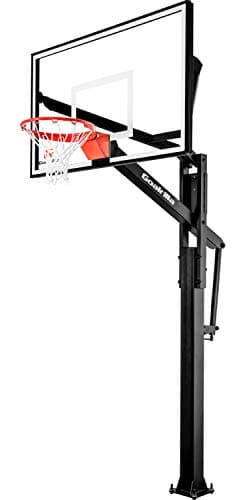
Goalrilla FT60
Limited lifetime warranty8.6/10Bolt-down on the 9-inch plate, so it unbolts and relocates. Note the warranty runs to the original retail purchaser only, so the term stays with you, not the house.
$2,379.75Amazon#ad · Price as of November 3, 2026 · Disclosure for the link to Goalrilla FT60
Best anchor kit for Goalrilla
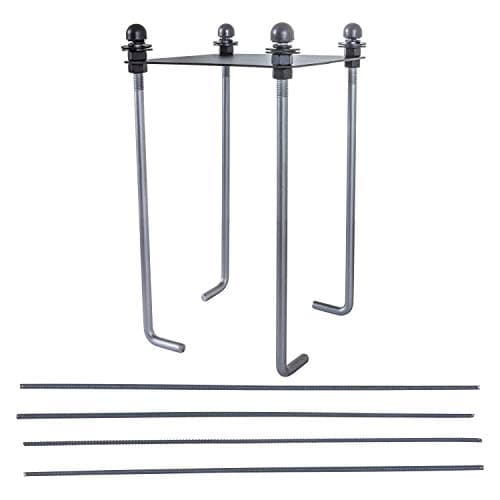
Goalrilla 9" Basketball Hoop Anchor Kit (B1002)
90-day warranty8.2/10The part that makes an in-ground hoop removable, and the part you buy a second time when you relocate one. About $110 to $150 more than direct-bury, up front.
$149.95Amazon#ad · Price as of November 3, 2026 · Disclosure for the link to Goalrilla 9" Basketball Hoop Anchor Kit (B1002)
Best portable overall
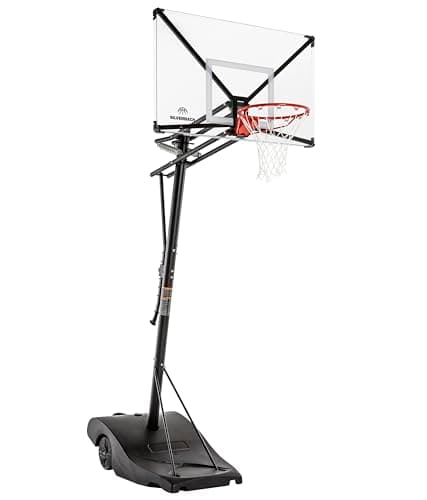
Silverback NXT 54 Portable
Warranty: not published7.9/10The no-question answer if a move is likely: personal property, 54 inches of board, and it goes in the truck.
$549.95Amazon#ad · Price as of November 3, 2026 · Disclosure for the link to Silverback NXT 54 Portable
How we picked
What earns a pick on this page
Every pick here is built from figures you can check for yourself: the maker's published backboard, pole, overhang and adjustment specs; the hole size, bag count and cure time printed in its install manual; the warranty term in the maker's own wording, exclusions included, with the date we read it; and the failure patterns owners report (base cracking, backboard fogging, two-piece pole lean), which shape the “skip this if” line. Every figure links to where it came from.
Those figures go through one fixed rubric, so an 8.1 here means the same thing as an 8.1 anywhere else on the site and the top pick is the one that earns it for the driveway it is named for. Commissions never set a score or decide a pick. The rubrics and their weights are published.
Questions
Frequently asked
Does a basketball hoop increase home value?
There is no published figure, and any page quoting a percentage invented it. A hoop does not appear on an appraisal: a portable is personal property, and an in-ground hoop is a non-habitable attachment with no market-standard adjustment. Its effect on a sale is emotional and cuts both ways — a selling point to a family with kids, a removal job to a buyer who does not want it.
Should I remove a basketball hoop before selling?
Take a portable — it is personal property. Leave a direct-bury in-ground hoop, because removing it means cutting the pole and patching, and a tidy hoop presents better than fresh concrete over a stub. A bolt-down hoop is genuinely your choice, which is the point of a bolt-down anchor. Either way, fix rust or shake before photos: a tired hoop reads as deferred maintenance on the whole property.
Does a basketball hoop warranty transfer to the new owner?
Goalrilla's warranty sheet says its limited lifetime term applies to the original retail purchaser, so no. Other makers publish less — Lifetime's FAQ states 5-year limited on most systems with glass breakage excluded, and several Escalade and Goalsetter product pages print no term at all. Treat the warranty as worth something to you and nothing to the buyer.
Is an in-ground basketball hoop considered a permanent fixture?
Practically, yes — a steel pole set in 750 to over 1,000 lb of concrete is attached to the land, and a direct-bury one cannot be removed intact. Whether it is legally a fixture in your sale is a contract question for your agent, not a basketball one. If you intend to take a bolt-down hoop with you, put it in writing in the listing rather than assuming.
What does it cost a buyer to remove a hoop they do not want?
For a bolt-down pole, an afternoon and the cost of capping or grinding the studs. For a direct-bury pole, an angle grinder or reciprocating saw to cut it at grade plus a patch, or a jackhammer and several hundred pounds of concrete rubble to dispose of if the footing itself has to go.
Keep reading
Related on Rim & Rebound
Receipts
Sources
- Goalrilla — Limited Lifetime Warranty (Escalade Sports warranty sheet as republished by BasketballGoalStore, an authorized dealer; read 2026-09-21)
- Goalrilla — Basketball Hoop Installation guide (read 2026-09-21)
- Goalrilla — 9" Basketball Hoop Anchor Kit (B1002) product page (read 2026-09-21)
- Goalrilla Anchor Kit B1002 — Anchor System Installation Instructions (PDF hosted by BasketballGoalStore; read 2026-09-21)
- Silverback SB60 (B5402W) owner's manual — anchor installation, assembly and Limited 7 Year Warranty (PDF hosted by Lowe's; read 2026-09-21)
- Silverback — 7" Basketball Hoop Anchor Kit (B1030) product page (read 2026-09-21)
- Amazon listing — Lifetime 90568 In-Ground 54-Inch Tempered Glass hoop: 3/8 in glass, crank adjust, bolt-down pole and concrete requirement (live Amazon listing, read 2026-10-04)
- Amazon listing — Lifetime Mammoth 90964 Bolt-Down 72-Inch hoop: 3/8 in glass, Mammoth Lift and bolt-down pole (live Amazon listing, read 2026-10-04)
- Lifetime — FAQ: "What is the warranty period on a Lifetime basketball system?" (read 2026-09-21)
- Lifetime — "Basketball Hoop Assembly: In-Ground and Bolt-Down" (read 2026-09-21)
- QUIKRETE — Concrete Mix No. 1101 data sheet (yields per bag, water, strength; read 2026-09-21)
- Thumbtack — basketball hoop installation cost (national average, updated Apr 14, 2026; read 2026-09-21)
- Amazon listing — Goalsetter Elite Plus 54" Tempered Glass In-Ground hoop (TS44154G3): crank adjustment, anchor mount, overhang and five-year warranty (live Amazon listing, read 2026-10-04)
- Silverback — NXT 54 Portable product page (read 2026-09-21)
Every figure above is a published one you can click and check. Specs come from the maker's own product pages (linked on every product), install figures from the maker's manual or installation page with the date we read it, and warranty terms from the maker's warranty page or manual. Buy buttons go straight to the current Amazon listing, so the price you see is today's. Where a maker leaves a figure off the page, the card says “not published” rather than guessing. Read how we pick.